The Dialogue Compass
A tool for reading the landscape of tension and finding a constructive way forward.
Work in Progress
A note about the name. We are abandoning the name Resistance Line and looking for an appropriate name for this tool which differs from its parent in many ways. We have considered the Polarity Compass (you might find some versions of this name in the texts) and many other names. For now, we’ll stick with Dialogue Compass. Any comments are helpful.
What is the Dialogue Compass?
The Dialogue Compass is an tool to understand tension. Its purpose is to help the practitioner understand how and when they can respond dialogically to situations that arise.
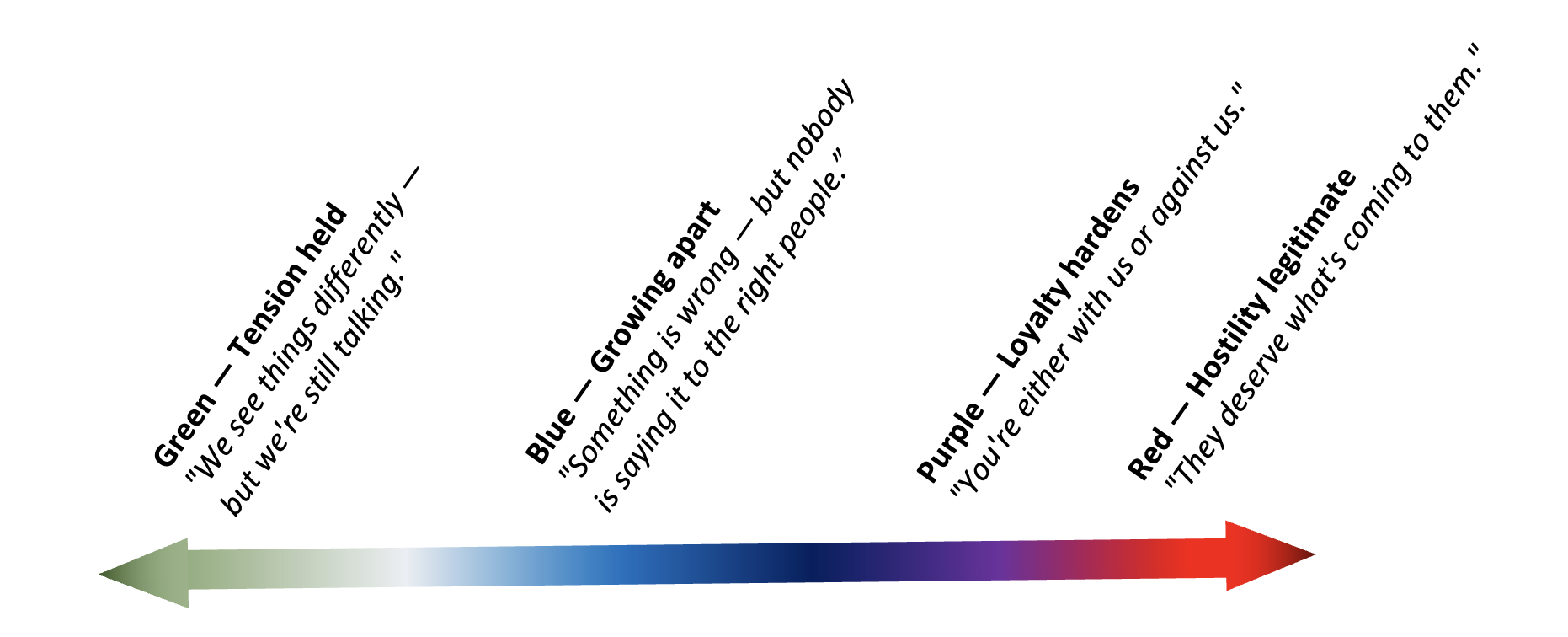
In its simplest form, it is a line with zones that track the development of tension in two directions: towards destructive tension and the countermovement towards less destructive, creative and constructive tension.
Note: This version is specifically designed for Youth Workers and is part of the Radix Project. A more general version will follow shortly
The Markers for Each Zone
Read more
A more detailed description of the Dialogue Compass.
The Zones in more detail
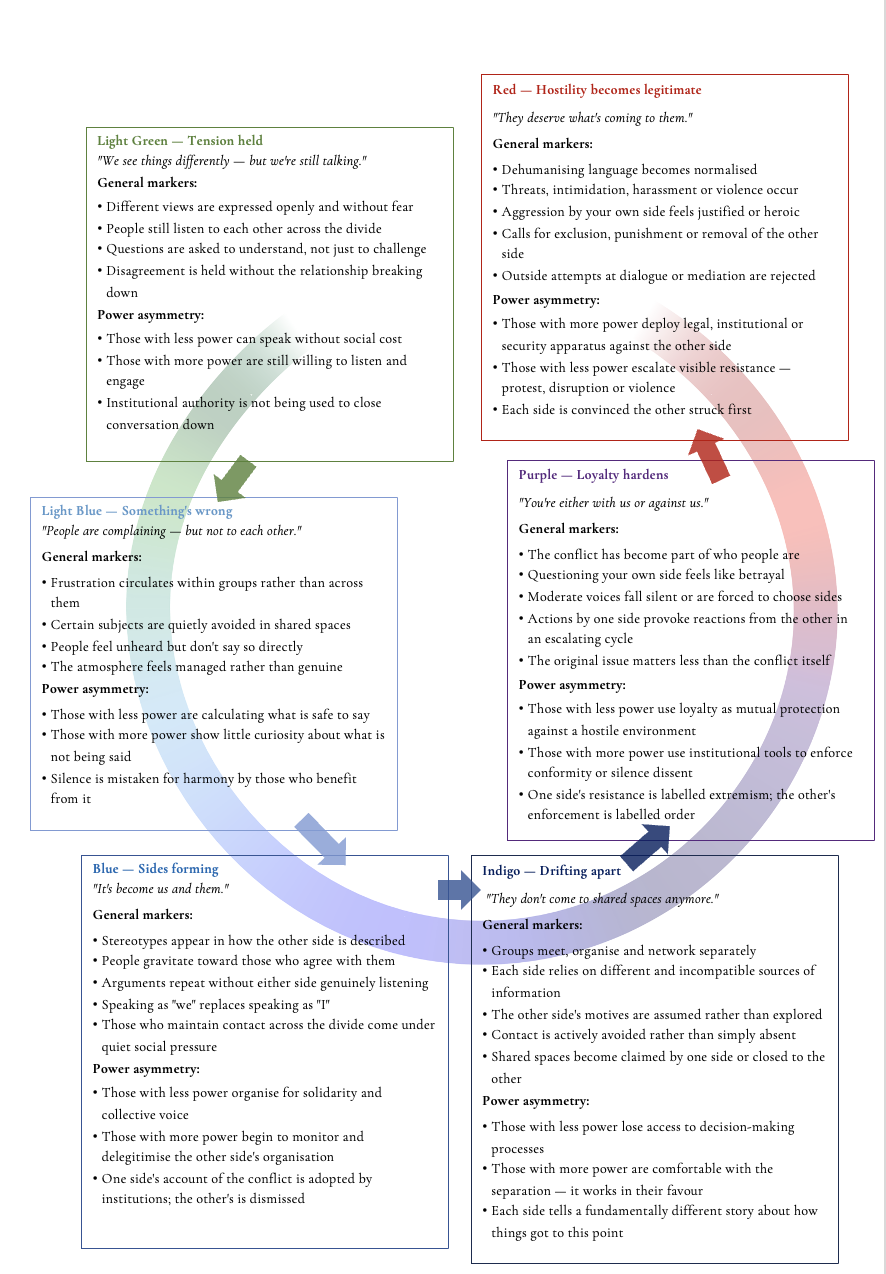
To the complete version
About the Dialogue Compass
What this tool is — and who it is for
The Dialogue Compass is a practical tool for people who work with young people and communities in tension. This version is designed primarily for youth workers and peace workers — people whose daily work involves building relationships, holding difficult conversations, and maintaining connection across difference. A version of this tool exists for other contexts — for institutional leaders, policy-makers, mediators working at a larger scale — but this is not that version. This version speaks to the practitioner who is in the room, who knows the young people involved, and who is often the first person to notice that something is shifting before anyone else has named it.
The tool has two purposes that are inseparable from each other. The first is diagnostic: it helps you read what is happening in a group or community, identify where on a spectrum of tension things currently stand, and understand the dynamics driving what you observe. The second is practical: for each stage of that spectrum, it offers guidance on what you could choose to do, what to avoid, and what the situation actually requires of you. These two purposes belong together because the most costly mistakes in conflict work come not from bad intentions but from misreading the situation — from intervening at the wrong level, with the wrong tools, at the wrong moment. Please treat the advice only as a direction pointer and not as a rule. Every situation will be different and in the end, the practitioner needs to consider her options carefully before acting.
This is a tool for prevention as much as for intervention. Its most important zone is not the Red zone, where hostility has become open and violent, but the Green zone, where relationships are being built and trust is being established before it is needed. Everything that follows in this tool — every thread of trust drawn on in a crisis, every relationship that survives escalation, every moment of connection that makes de-escalation possible — has its roots in what was or was not built while things were still going well.
The intellectual roots of the tool
The Polarisation Compass grew out of an earlier framework called the Resistance Line inspired by Myrna Lewis, which was itself rooted in two distinct but complementary bodies of thought.
The first is the work of Arnold Mindell whose approach to group conflict proceeds from the insight that marginalisation is a primary driver of escalation. In any group or society, certain voices, perspectives, and experiences are pushed to the margins — not heard, not taken seriously, not reflected in the decisions that affect them. That marginalisation does not disappear. It accumulates. And it finds expression, eventually, in conflict. Mindell’s work insists that the practitioner must attend not only to what is visible and loud but to what has been silenced and pushed aside — because it is there that the real drivers of conflict are most often found.
The second is the work of David Bohm, the physicist and philosopher whose thinking on fragmentation describes something complementary. Bohm observed that human communities — and human thinking itself — tend toward fragmentation: the breaking apart of what was once a whole into separate, increasingly incompatible pieces. Groups that once shared a common space, a common conversation, a common reality begin to inhabit different worlds — separate networks, separate sources of information, separate accounts of what is happening and why. This fragmentation, Bohm argued, is not simply the result of conflict. It is one of its primary causes.
These two insights are brought together in the Polarisation Compass. Marginalisation and fragmentation are not the same thing — but they are deeply connected. Fragmentation may appear symmetrical: both sides are moving apart, both sides are losing contact with the other, both sides are developing their own account of reality. But it is rarely symmetrical in cause or experience. The fragmentation that looks like mutual drift is almost always driven, at its root, by the marginalisation of a voice, a perspective, or a group that was not heard when it could still be heard relatively easily.
This matters practically. A tool that only describes the behaviour of the less powerful, more visible, more disruptive side of a conflict inadvertently frames escalation as something the marginalised do. The Polarisation Compass proceeds from a different assumption: that escalation is rarely one-sided. For every group that hardens into a cause, there is typically an institution, an authority, or a dominant group that has hardened into a security posture. Each reads the other’s hardening as confirmation of their own. The activist sees repression. The authority sees threat. Both are right about what they observe. Neither sees the whole.
The practitioner who understands this is equipped not only to work with those at risk but to challenge institutional responses that make the situation worse.
The Compass consists of six zones. Each indicates another level of tension.
Read more by clicking on the tabs below.
How the Tool is Structured
The Dialogue Compass maps a spectrum of tension across seven zones, each identified by a colour. At one end — Light Green — tension is present but held: different views are expressed, people are still in genuine contact, and the conditions for constructive engagement exist. At the other end — Red — hostility has become legitimate, violence or its equivalent has occurred, and the tools available to the regular practitioner are severely limited.
Between these poles lie five further zones — Light Blue, Blue, Indigo, Purple, and beyond Red, a zone called Dark Red — each describing a qualitative shift in how the conflict is being experienced and what it requires. These are not simply points on a scale of intensity. Each zone represents a different kind of situation, requiring a different kind of response. The most consequential moments in the tool are not the zones themselves but the thresholds between them — the points at which a dynamic becomes a structure, a cost becomes an obligation, a grievance becomes an identity. Learning to recognise those thresholds, and to act before they are crossed, is one of the most important skills the tool develops.
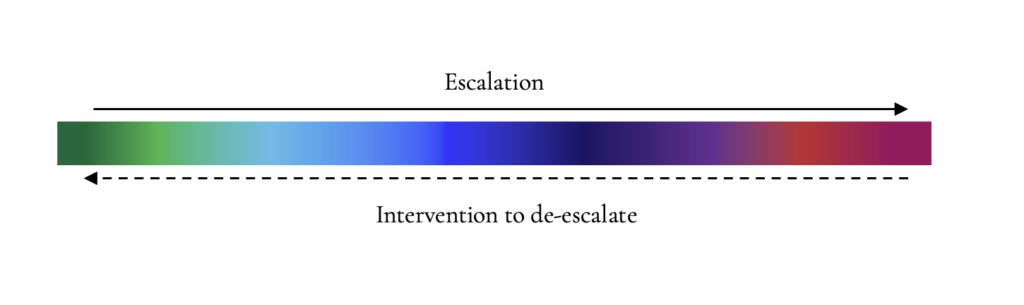
The tool can be presented as a line — which emphasises the logic of escalation and makes it easy to see where a situation currently stands — or as a compass — which emphasises that the direction of travel is not fixed, that de-escalation is always possible, and that the zones at the far end of the line are, in the compass format, closest to the zones at the beginning.
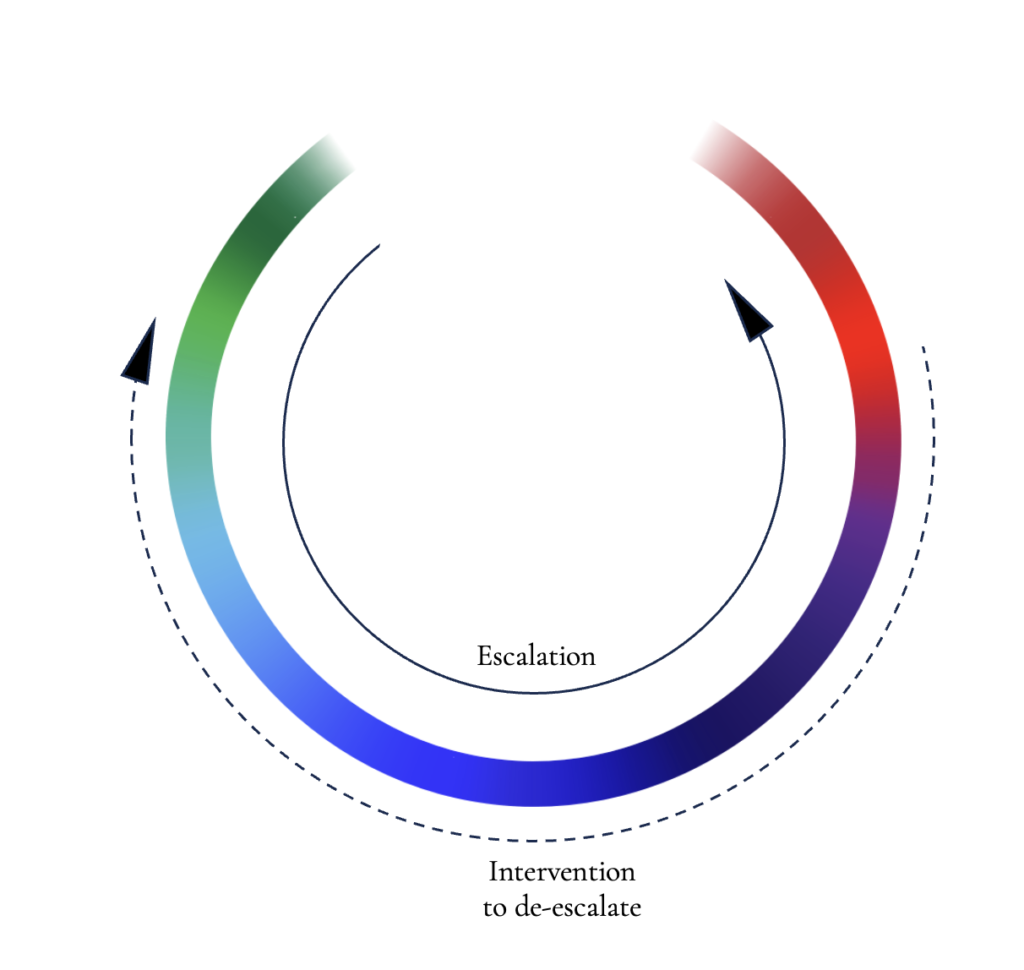
That proximity is not accidental. It is the tool’s most important structural truth: the way back from the deepest conflict runs through the relationships and trust built at the very beginning. Green and Red are not opposites. They are neighbours, separated by a long arc but connected at the edges.
The tool is bidirectional. Escalation is not inevitable. De-escalation is always possible, though it becomes progressively harder, slower, and more fragile the further along the spectrum a situation has travelled. The arrow points both ways — and that is not optimism. It is the most important practical truth the tool contains.
The Zones at a Glance
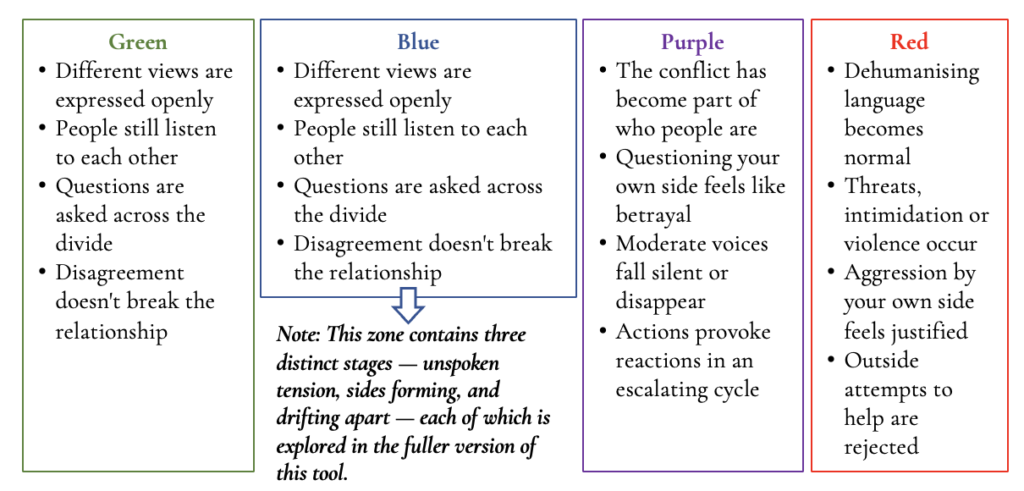
Light Green — Tension held
“We see things differently — but we’re still talking.”
Different views are expressed openly. People still listen to each other across the divide. Questions are asked to understand, not just to challenge. Disagreement is held without the relationship breaking down.
Light Blue — Something’s wrong
“People are complaining — but not to each other.”
Frustration circulates within groups rather than across them. Certain subjects are quietly avoided. People feel unheard but don’t say so directly. The atmosphere feels managed rather than genuine.
Blue — Sides forming
“It’s become us and them.”
Stereotypes appear in how the other side is described. People gravitate toward those who agree with them. Arguments repeat without either side genuinely listening. Speaking as “we” replaces speaking as “I.”
Indigo — Drifting apart
“They don’t come to shared spaces anymore.”
Groups meet and organise separately. Each side relies on different and incompatible sources of information. The other side’s motives are assumed rather than explored. Contact is actively avoided rather than simply absent.
Purple — Loyalty hardens
“You’re either with us or against us.”
The conflict has become part of who people are. Questioning your own side feels like betrayal. Moderate voices fall silent or disappear. Actions provoke reactions in an escalating cycle.
Red — Hostility becomes legitimate “
They deserve what’s coming to them.”
Dehumanising language becomes normal. Threats, intimidation, or violence occur. Aggression by your own side feels justified. Outside attempts to help are rejected.
Dark Red — Elimination
This zone sits beyond the scope of this tool’s intervention advice. It is included not because practitioners are expected to work within it, but because its existence on the scale serves a specific purpose: it marks the horizon that the entire tool is designed to help people avoid reaching. Understanding that a trajectory exists — that the logic of each zone, if unchecked, points toward the next — is itself a reason to act earlier.
Three practices that run through the whole tool
Before entering the zone-by-zone advice, three practices need to be introduced. They are not zone-specific — they belong to every stage of the work, from the earliest Green zone intervention to the most difficult Red zone presence. They are named here so that they can be referenced throughout the tool without being re-explained in full at each stage.
Read more about the Three Practices
1. The Practitioner’s Positionality
You are not neutral — and pretending to be will undermine your work from the beginning. You carry assumptions, experiences, values, and a particular lens through which you see what is happening. Your role, your institutional affiliation, your cultural background, your own history of inclusion or exclusion — all of these shape what you notice, whose discomfort you register first, whose account of a situation feels more natural to you.
This is not a failing. It is the human condition. But if it goes unexamined, it will shape your practice in ways you cannot see or correct.
The discipline the tool requires throughout is not neutrality but honest self-awareness — the continuous practice of questioning your own assumptions, noticing your own lens, and asking yourself what you might be missing because of where you stand. This practice begins in the Green zone and intensifies at every subsequent stage. It is not a preliminary to the work. It is the work.
A related discipline is what this tool calls multi-partiality: not the pretence of standing above the situation, but the practice of being fully present and genuinely empathetic with each side — including the side whose position you find harder to hold. Multi-partiality cannot be performed at crisis point. It must be demonstrated, consistently and over time, from the earliest stages of contact. By the time you reach the later zones of this tool, your reputation for it — or the absence of that reputation — will already have been established.
2. Dialogue Beyond Words
Dialogue is not only what happens when people talk.
Connection, mutual recognition, and the beginning or restoration of trust can emerge through shared physical or artistic activity — making music together, dancing, painting, drawing, building, walking, gardening, cooking, playing. These are not warm-up exercises before the real work begins. For many young people, and in many cultural contexts, they are the real work. The move from hardened positions back toward shared humanity does not always travel through words. Sometimes it travels through rhythm, movement, or the quiet concentration of making something together.
This is particularly important in youth work, where the young people you work with may not yet have — or may have lost — the language to articulate what they are experiencing. Structured conversation is not always accessible, not always safe, and not always the most powerful form of contact available. The practitioner who only knows how to facilitate conversation is working with a fraction of the available tools — and may be unconsciously privileging a form of communication that not everyone finds equally accessible or safe.
What this looks like in practice:
Music, drumming, dance and movement are particularly relevant in youth contexts where these are already lived cultural practices rather than imported techniques. Visual art, drawing, painting, and collage allow expression without requiring verbal articulation. Building and making — constructing something physical together — requires negotiation and cooperation without anyone needing to name the conflict. Walking side by side rather than face to face changes the relational geometry of a conversation entirely. Gardening, cooking, and shared physical tasks provide a third point of focus that reduces the intensity of direct encounter. Play and games are not trivialisation — they are genuine ground for contact, particularly with younger groups.
A note on cultural humility:
The knowledge of how to use these methods is often already present in the group — in its cultural practices, its youth culture, its existing forms of gathering and celebration. Hip-hop, for example, is not an external technique to be introduced by a practitioner. It is a living tradition that already carries within it practices of dialogue, conflict, testimony, and community-building. The practitioner’s role is not always to bring something new. It is sometimes to notice, name, and protect what is already happening, and to create institutional space for it to continue.
Throughout this tool, you will be asked to return to this question:
What forms of connection already exist in this group that I have not yet recognised as dialogue?
A note on institutional resistance:
These approaches are often undervalued at the institutional level — seen as supplementary to the real work of structured intervention. Practitioners who use them may need to articulate clearly why they are doing so. The evidence base for arts-based and embodied approaches to conflict transformation and community-building is substantial. Knowing that evidence exists, and being able to name it, is part of the practitioner’s professional equipment.
3. The Reflective Pause
There is a momentum that builds in conflict situations — a pressure toward action, decision, response. Something happens and the instinct is to do something: convene a meeting, bring people together, name the issue, call in support. That instinct is not wrong. But acted on too quickly, it can move the situation forward before anyone understands what is actually driving it.
The reflective pause is a deliberate interruption of that momentum. It is a choice — made by the practitioner alone, with a colleague, or where appropriate with the group itself — to stop before acting and ask the prior question: what lies beneath this?
This is not passivity. It is the most active thing a practitioner can do at the moment when action feels most urgent. It requires courage, because the pressure from all sides — including from within yourself — will be to move, to fix, to respond. Choosing to pause, to sit with what is not yet understood, is a discipline that has to be practised.
Unpacking — or deconstruction — is the heart of it. When tension surfaces, when a young person says something hostile, when a group hardens around a position, the reflective pause asks you to resist the surface and go underneath. Not what is happening but what is driving what is happening. Not what did they say but what do they need that they are not getting.
This unpacking can happen at several levels:
Alone, as an internal practice — sitting with what you have observed, resisting premature interpretation, asking yourself what you might be missing. With a colleague or team — pooling observations, checking each other’s assumptions, designing next steps together from a shared understanding rather than a reactive one. With the group or individuals within it — creating a reflective space in which people can begin to ask themselves, facilitated and without pressure, what is really going on for them. This is the moment when unmet needs most often surface — not when they are asked directly, but when enough safety exists for people to look at their own experience without defending it.
When the reflective pause is practised well, something often happens that no direct intervention produces: new ways forward begin to emerge from within the group rather than being imposed from outside. The practitioner does not need to have the answer. They need to have created the conditions in which the answer can be found.
Throughout this tool, you will be asked to return to this question:
What is being expressed here — and what lies beneath the expression that has not yet been said?
A Note on Trauma
Running through every zone of this tool, and intensifying as the zones deepen, is the presence of trauma. Marginalisation, exclusion, humiliation, and violence — whether psychological or physical — leave marks that are not always visible but that shape perception, trust, memory, and the capacity for dialogue in profound ways.
Trauma is not only the experience of dramatic events. It includes the accumulated weight of not being heard, of being excluded from decisions that affect you, of having your account of reality dismissed, of belonging to a group whose existence is questioned or whose dignity is denied. These experiences are present, in different forms and at different intensities, at every stage of this tool — from the Light Blue zone, where people have stopped trusting the shared space enough to speak honestly, to the Red zone, where hypervigilance and hair-trigger reactions are not character flaws but trauma responses.
Any practitioner working with this tool needs trauma awareness as a baseline orientation — not as a specialist addition but as a fundamental lens. At the more advanced zones, access to trauma-informed support — for participants and for the practitioner themselves — is not optional. It is a condition of responsible intervention.
A particular note for youth workers: young people may not have language for what they are carrying. The hostility, the withdrawal, the hardening into group identity — these are often expressions of something that has not yet been able to be named. The question what did this person need that they did not get? is a trauma-informed question. It looks beneath the symptom toward the unmet need, and it is one of the most important questions available to the practitioner at every stage of this work.
A Note on Digital Drivers of Polarisation
Running through every zone of this tool, and intensifying as the zones deepen, is the presence of trauma. Marginalisation, exclusion, humiliation, and violence — whether psychological or physical — leave marks that are not always visible but that shape perception, trust, memory, and the capacity for dialogue in profound ways.
Trauma is not only the experience of dramatic events. It includes the accumulated weight of not being heard, of being excluded from decisions that affect you, of having your account of reality dismissed, of belonging to a group whose existence is questioned or whose dignity is denied. These experiences are present, in different forms and at different intensities, at every stage of this tool — from the Light Blue zone, where people have stopped trusting the shared space enough to speak honestly, to the Red zone, where hypervigilance and hair-trigger reactions are not character flaws but trauma responses.
Any practitioner working with this tool needs trauma awareness as a baseline orientation — not as a specialist addition but as a fundamental lens. At the more advanced zones, access to trauma-informed support — for participants and for the practitioner themselves — is not optional. It is a condition of responsible intervention.
A particular note for youth workers: young people may not have language for what they are carrying. The hostility, the withdrawal, the hardening into group identity — these are often expressions of something that has not yet been able to be named. The question what did this person need that they did not get? is a trauma-informed question. It looks beneath the symptom toward the unmet need, and it is one of the most important questions available to the practitioner at every stage of this work.
A Note on Digital Drivers of Polarisation
Running through every zone of this tool, and intensifying as the zones deepen, is the presence of trauma. Marginalisation, exclusion, humiliation, and violence — whether psychological or physical — leave marks that are not always visible but that shape perception, trust, memory, and the capacity for dialogue in profound ways.
Trauma is not only the experience of dramatic events. It includes the accumulated weight of not being heard, of being excluded from decisions that affect you, of having your account of reality dismissed, of belonging to a group whose existence is questioned or whose dignity is denied. These experiences are present, in different forms and at different intensities, at every stage of this tool — from the Light Blue zone, where people have stopped trusting the shared space enough to speak honestly, to the Red zone, where hypervigilance and hair-trigger reactions are not character flaws but trauma responses.
Any practitioner working with this tool needs trauma awareness as a baseline orientation — not as a specialist addition but as a fundamental lens. At the more advanced zones, access to trauma-informed support — for participants and for the practitioner themselves — is not optional. It is a condition of responsible intervention.
A particular note for youth workers: young people may not have language for what they are carrying. The hostility, the withdrawal, the hardening into group identity — these are often expressions of something that has not yet been able to be named. The question what did this person need that they did not get? is a trauma-informed question. It looks beneath the symptom toward the unmet need, and it is one of the most important questions available to the practitioner at every stage of this work.
A Final Note on This Version of the Tool
This version of the Polarisation Compass is written specifically for youth workers and peace workers — people whose daily practice involves direct, relational work with young people and communities. The language, the examples, and the level of intervention described throughout are calibrated for that audience.
The framework is applicable beyond that context. Polarisation dynamics operate in workplaces, in political institutions, in communities of faith, in educational settings, and at the level of whole societies. Future versions of this tool will be developed for those contexts. What will remain constant across versions is the underlying framework — the zones, the thresholds, the power asymmetry analysis, and the structural logic that connects them.
What will change is the practitioner, their role, their institutional context, and therefore what intervention looks like at each stage. A policy-maker reading the Indigo zone needs different guidance from a youth worker reading it. An institutional leader reading the Purple zone needs different guidance from a community mediator. Those versions are forthcoming.
For now, this tool speaks to the person who is in the room, who knows the young people, and who is often the only person present when the first signs appear. That person is the most important actor in the entire framework — not because they can resolve the conflict alone, but because they are there, at the beginning, when the conditions are still being shaped. What they do — and what they build — in the Green zone determines what is available to everyone who comes after them.