The Blue Zone
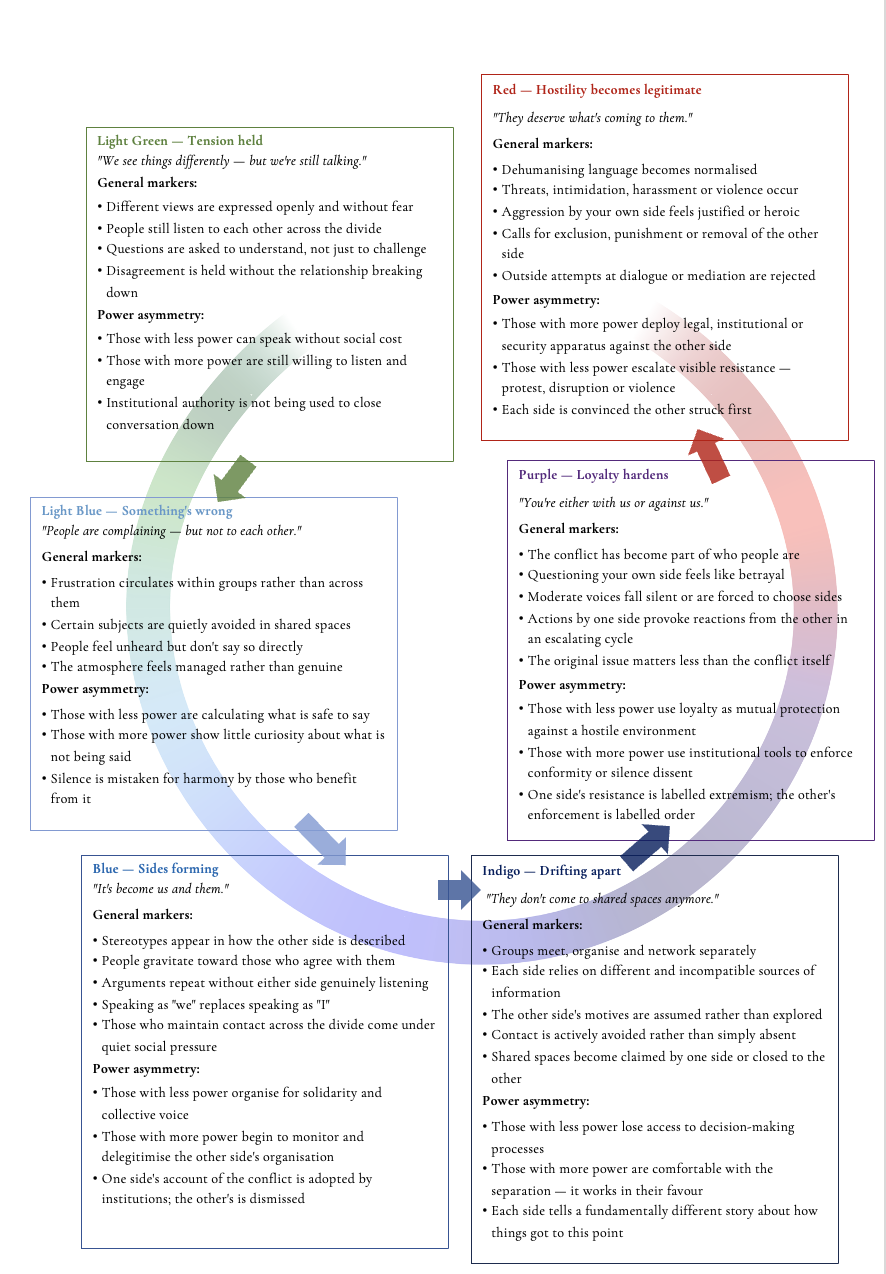
“It’s become us and them.”
Light Green
Light Blue
Blue
Indigo
Purple
Red
The primary shifts between Light Blue and Blue
From private to structural In Light Blue, tension lives in individual experience — people feel something is wrong but carry it privately or within their immediate circle. In Blue, that private feeling has found collective form. Groups have begun to organise around it. The tension is no longer just felt; it has shape and membership. This is a qualitative shift, not just an intensification.
From avoidance to contest Light Blue is characterised by withdrawal — people stop saying things. Blue is characterised by assertion — people start saying we. The energy shifts from inward to outward. Silence gives way to argument, but argument that hardens rather than explores.
From relational to identity In Light Blue, the tension is about an issue. In Blue, the issue is becoming attached to who people are. This is the beginning of the identity fusion that fully crystallises in Purple. The stakes rise significantly — because now engaging with the other side’s view feels like a threat to self, not just a disagreement.
From recoverable to effortful Light Blue can be addressed by relatively light-touch facilitation — creating space, naming what is unspoken. Blue requires more deliberate effort because the structural conditions for further escalation are now in place. Sides exist. Crossing them costs something.
The most dangerous shift — and the most commonly missed: The practitioner’s role changes fundamentally. In Light Blue they could work with the whole group relatively naturally. In Blue, approaching the whole group as if it were still whole is itself a mistake — it may be read by one or both sides as naivety or bias. The practitioner must now consciously manage their relationship with each side, not just the room.
One critical asymmetry to flag: In power-asymmetric situations, the Blue zone often looks very different depending on which side you observe first. The less powerful group’s solidarity looks like escalation. The more powerful group’s defensive organisation is often invisible because it happens through existing structures. A practitioner who only sees the visible side of the organising will systematically misread the situation.
Blue – Sides form
People begin to organise themselves around different views. Debate becomes more us and them. What was previously a matter of differing opinions is hardening into group identity. Where power is unequal, this stage often looks different on each side of the divide: those with less power organise out of necessity, seeking solidarity and collective voice; those with more power may organise defensively, perceiving the other side’s solidarity as a threat to the existing order.
General markers:
- Stereotypes begin to appear in how the other side is described.
Are people describing the other side in generalised or dismissive terms rather than engaging with their actual views? - Alliances form and informal networks solidify around shared positions.
Are people gravitating toward those who agree with them and distancing themselves from those who don’t? - Arguments become repetitive — positions are stated rather than explored. Are the same points being made over and over without either side genuinely engaging with the other’s reasoning?
- Emotional temperature rises.
Do exchanges feel more like battles to be won than problems to be solved together? - Language shifts from “I think” to “we believe” — the group speaks as one.
Are individuals speaking on behalf of their group rather than from their own experience or reasoning? - Cross-divide relationships come under quiet social pressure.
Are people who maintain contact with the other side being questioned or made to feel disloyal by their own group? - The other side’s motives are questioned rather than engaged with.
Are people dismissing why the other side acts as it does rather than trying to understand it?
Asymmetric power markers
- Those with less power find strength and validation in solidarity.
Are those who feel unheard or marginalised drawing together for mutual support and collective voice? - Those with more power begin to monitor, question, or delegitimise the other side’s organisation.
Are those in authority treating the other side’s organising as a threat rather than a legitimate response? - One side’s framing of the situation is adopted by institutions, media, or official channels; the other side’s framing is marginalised or dismissed. Whose account of the conflict is being treated as objective — and whose is being treated as biased or troublesome?
Advice
Dialogue Beyond Words
A note on what this section is: The advice throughout this tool assumes that the practitioner’s primary instrument is conversation — creating space for it, facilitating it, protecting it. This section pauses that assumption. It is not a replacement for the advice elsewhere. It is a parallel track, and for some groups, some contexts, and some individuals, it may be the more important one.
Why this matters at the Blue zone
When sides are forming and trust is eroding, direct conversation about the tension carries risk. It can harden positions, trigger defensiveness, or force people to declare allegiances they are not yet ready to name. Shared activity that does not require anyone to take a verbal position can create conditions for contact that conversation alone cannot. The experience of making something together, moving together, or being absorbed in a shared challenge can produce moments of recognition — this person is also human, also capable of joy or concentration or humour — that no facilitated dialogue exercise reliably generates.
What this looks like in practice
- Music, drumming, dance and movement — particularly relevant in youth contexts where these are already lived cultural practices, not imported techniques.
- Visual art, drawing, painting, collage — activities that allow expression without requiring verbal articulation.
- Building and making — constructing something physical together, which requires negotiation and cooperation without naming either.
- Walking — side by side rather than face to face, which changes the relational geometry of a conversation entirely.
- Gardening, cooking, shared physical tasks — where the activity provides a third point of focus that reduces the intensity of direct encounter.
- Play and games — not as trivialisation but as genuine ground for contact, particularly with younger groups.
A note on cultural humility
The knowledge of how to use these methods is often already present in the group — in its cultural practices, its youth culture, its existing forms of gathering and celebration. Hip-hop, for example, is not an external technique to be introduced by a practitioner; it is a living tradition that already carries within it practices of dialogue, conflict, testimony and community-building. The practitioner’s role here is not always to bring something new. It is sometimes to notice, name and protect what is already happening, and to create institutional space for it to continue.
Ask yourself: what forms of connection already exist in this group that I have not yet recognised as dialogue?
A note on institutional resistance
These approaches are often undervalued at the institutional level — seen as entertainment, distraction, or supplementary to the real work of conversation and structured intervention. Practitioners who use them may need to articulate clearly why they are doing so and what they are observing as a result. The evidence base for arts-based and embodied approaches to conflict and community-building is substantial, even if it does not always reach the institutions that fund youth work. Knowing that evidence exists, and being able to name it, is part of the practitioner’s professional equipment.
Practitioner’s Stance
As sides begin to form and us-and-them language appears, your relationship to each side becomes critical. The word neutrality is commonly used here, but it is misleading — what is required is not distance but multi-partiality: being fully present and empathetic with each side, rather than hovering above them all. Any sign that you favour one side — however subtle — makes the space unsafe for the other. In power-asymmetric situations this is particularly demanding: genuine neutrality is impossible, and pretending otherwise will damage trust with the less powerful group first.
Watch your own reactions carefully. Notice what triggers you, whose arguments feel more reasonable to you, whose frustration you find easier to sit with. That self-knowledge is not incidental — it is part of your professional equipment at this stage.
When you observe differing positions hardening into group identity, resist the temptation to treat this as simply the natural intensification of disagreement. Ask yourself the deeper question: what is driving this? Are there unmet needs beneath the positions? Accumulated grievances that were never heard? Structural conditions — exclusion, inequality, lack of voice — that are now finding collective expression? The practitioner who only sees the surface of the conflict will intervene at the wrong level.
Be aware that awareness itself is not enough — but that without it, nothing else is possible. The quality of your presence determines whether the space is safe enough for what needs to happen next.
A note on awareness, safety and dialogue
Awareness in this context is not passive observation. It is not simply naming what arises or noticing the temperature in the room. It is an active, generative capacity — the quality of attention that makes safety possible, which in turn makes genuine dialogue possible.
When a practitioner is fully present — attending not just to what is said but to what is felt, avoided, performed and hidden — the room itself becomes safer. People begin to sense that they are genuinely seen. And when people feel genuinely seen, they become capable of something that no technique can produce directly: the willingness to speak from their own lived experience rather than from their group position.
Stories of lived experience are among the most powerful forces available in conflict work. They move people across divides that argument cannot cross, because they do not ask anyone to abandon their position — they ask only that they recognise another person’s humanity. But those stories cannot be forced or facilitated into existence. They can only emerge when the safety is real.
The sequence is therefore: awareness → safety → openness → stories of lived experience → recognition of shared humanity → movement toward connection.
This sequence cannot be shortcut. Jumping to dialogue before the safety exists does not accelerate the process — it damages it. The practitioner’s awareness is not a preliminary to the work. It is the foundation on which everything else rests.
This also means that awareness at its deepest level is a facilitation skill of the highest order — not a personal quality that some people happen to have, but a professional capacity that can be developed, practised, and deepened throughout a career. Naming it explicitly, and taking it seriously as a discipline, is one of the things that distinguishes skilled conflict work from well-intentioned improvisation.
Dialogue at this stage is not only what happens when people talk. Connection, mutual recognition, and the beginning of restored trust can emerge through shared physical or artistic activity — making music together, dancing, painting, drawing, building, walking, gardening. These are not warm-up exercises before the real work begins. For many young people, and in many cultural contexts, they are the real work. The move from hardened positions back toward shared humanity does not always travel through words. Sometimes it travels through rhythm, movement, or the quiet concentration of making something together.
Ask yourself: what forms of connection already exist in this group that I have not yet recognised as dialogue?
Immediate Response
Do:
- Notice and name us-and-them language and gossip when you observe it — calmly, without drama, and without taking sides. “I notice we are speaking about X rather than to them — can we think about that?”
- Meet with the different groups separately before attempting any joint work. Each side needs to feel genuinely heard before they can hear the other. This is not a preliminary — it is the work itself.
- In those separate meetings, don’t just listen — ask questions, validate emotions, and gently challenge assumptions. Help people verbalise what they are feeling and, where possible, explore what lies beneath the emotion toward the experience that drives it.
- Explore mistrust before debating positions. Ask not just what people think but why they feel as they do. The emphasis at this stage shifts from positions to relationships, and from argument to experience.
- Identify key people — natural leaders, trusted figures, those with relationships on both sides. Approach them not as subjects of your intervention but as collaborators. Ask for their help. This is not a technique — it is a genuine redistribution of agency. When someone is asked for their help rather than managed toward a goal, the power dynamic shifts. They become co-designers of what happens next rather than participants in your process.
- Begin to map what each group is saying about the other. This is diagnostic information, not material to be carried between groups.
- Document what you are observing — patterns, shifts, specific incidents. Memory is unreliable under pressure, and a record becomes essential if the situation escalates.
- Prepare carefully before any joint conversation. The dialogue does not begin when people sit in the same room. It begins during the preparation — in the individual conversations, the trust built, the expectations clarified, the risks identified. A joint meeting that has not been prepared is not a shortcut. It is a risk.
Don’t:
- Ignore or minimise the tension. Hoping it will resolve itself at this stage is a choice to allow escalation.
- Arrange a joint conversation before each side has felt genuinely heard separately. Premature joint conversation at Blue can accelerate movement toward Indigo rather than reverse it.
- Become a messenger between groups. What you learn separately informs your understanding — it does not become material to report to the other side.
- Confirm or implicitly validate stereotypes by allowing them to pass unchallenged.
- Treat the visible organising of the less powerful group as the primary problem while missing the defensive organising of the more powerful group, which often happens through existing structures and is therefore less visible.
- Challenge or attempt to dismantle group identity directly — particularly for those whose group membership represents protection, survival or dignity. If people feel that their identity or sense of belonging is being questioned, you become the other side. Your trust is blown. The first task is never to move people out of their identity. It is to create enough safety that they can, in time, choose to look beyond it.
- Assume that raising awareness alone will produce change. Awareness is essential — but thin awareness can sometimes make managed division more conscious and therefore more stable. What awareness must lead toward is the safety and openness in which something can actually shift.
What this looks like in practice:
- Music, drumming, dance and movement — particularly relevant in youth contexts where these are already lived cultural practices rather than imported techniques.
- Visual art, drawing, painting, collage — activities that allow expression without requiring verbal articulation.
- Building and making — constructing something physical together, which requires negotiation and cooperation without anyone needing to name the conflict.
- Walking — side by side rather than face to face, which changes the relational geometry of a conversation entirely.
- Gardening, cooking, shared physical tasks — where the activity provides a third point of focus that reduces the intensity of direct encounter.
- Play and games — not as trivialisation but as genuine ground for contact, particularly with younger groups.
A note on cultural humility:
The knowledge of how to use these methods is often already present in the group — in its cultural practices, its youth culture, its existing forms of gathering and celebration. The practitioner’s role is not always to introduce something new. It is sometimes to notice, name and protect what is already happening, and to create institutional space for it to continue.
Ask yourself: what forms of connection already exist in this group that I have not yet recognised as dialogue?
A note on institutional resistance:
These approaches are often undervalued at the institutional level — seen as supplementary to the real work of structured intervention. Practitioners who use them may need to articulate clearly why they are doing so. The evidence base for arts-based and embodied approaches to conflict and community-building is substantial. Knowing that evidence exists, and being able to name it, is part of the practitioner’s professional equipment.
Longer Term
- When each side has felt heard, create structured opportunities for the groups to speak together. Facilitate these conversations carefully — the goal is not to resolve the conflict immediately but to restore the experience of being in the same room without the conversation becoming a contest.
- Help groups identify what is happening to them collectively. Build their awareness of stereotyping, us-and-them language, and the subtle signs of drift. A group that can name its own dynamics has begun to develop its own immune system.
- Teach and model basic dialogue principles — speaking from experience rather than on behalf of a group, asking questions to understand rather than to challenge, distinguishing observation from interpretation. Over time, the group builds the capacity to have these conversations without your facilitation.
- Where possible, work toward a shared agreement about how differences will be handled. This does not need to be formal — even a light, explicit understanding that disagreement is expected and manageable is worth establishing.
- Where you are working as part of a team, use that collective resource deliberately. Different practitioners will have different relationships with different individuals and groups. Map those relationships consciously. Meet regularly to pool what you are each observing, and design next steps together. The awareness that no single practitioner can hold alone becomes possible when it is shared across a team. The team itself models the kind of collaborative, multi-perspective thinking you are trying to build in the group.
- Know your own limits. If the situation is moving faster than you can manage, or if you find yourself losing multi-partiality, this is not a personal failure — it is information. Have a clear route to supervision or consultation, and use it.
Conditions
- Each side trusts the practitioner sufficiently to speak honestly — and does not feel judged for what they reveal.
- There is time and space to meet with groups separately before bringing them together.
- The group has sufficient prior experience of dialogue that a facilitated conversation does not feel alien or threatening.
- Before creating a shared space for difficult conversation, assess whether equal psychological safety actually exists for all participants. If some people’s identities, dignity or sense of belonging are already under direct pressure from others in the group, the conditions for open joint dialogue may not yet exist. Creating that space prematurely does not accelerate the process — it can cause harm.
- External events — political, social, media — are not so overwhelming that they continuously re-ignite the tension before it can be worked with. Where they do intrude, they can be named and spoken about openly.
- The practitioner has access to supervision or support, and knows when to use it.
- Power differentials within the group are visible to the practitioner, even when they are not visible to the group itself.
Signs of Escalation
The following signals suggest that the zone is shifting and that Indigo-zone dynamics may already be forming:
- Groups are no longer simply gravitating toward each other — they are beginning to organise separately, with distinct meeting patterns, communication channels, and internal networks.
- Each side is developing its own account of how things got to this point — and the two accounts are becoming incompatible.
- Individuals who still have relationships on both sides are beginning to feel the pressure to choose. When these bridge people start to fall silent or withdraw, the last natural channels of communication are closing.
- The other side’s motives are no longer questioned — they are assumed. Curiosity about the other side has been replaced by certainty about them.
- Be alert to digital spaces. If the in-room atmosphere feels calmer while the tension you know exists seems to have nowhere to go, it has likely migrated online. Private channels, group chats and social media may be carrying the conflict that has disappeared from the shared space. This is one of the most easily missed escalation signals at this stage.
- One side’s account of the conflict is being adopted by institutional structures while the other’s is being dismissed or ignored. When this happens, the institution has effectively joined one side — and the less powerful group will read it as such, accelerating their withdrawal.
When these signals appear, the approach required is shifting from facilitated dialogue toward something closer to mediation — and the question of whether specialist support is needed becomes urgent.
Practitioner’s Dilemma
Two related dilemmas surface at this zone that the tool cannot resolve — and that practitioners should not attempt to resolve prematurely.
The identity dilemma: When sides are forming around group identities — particularly where those identities represent protection, dignity or survival for the less powerful group — the practitioner faces a profound tension. To challenge the identity directly is to become the other side. To leave it entirely unchallenged is to allow the hardening to continue. The question is not whether to engage with identity but how — and the answer almost always involves creating enough safety and trust that people can begin to look beyond their position voluntarily, in their own time, rather than being pushed.
Does awareness sometimes do the job here? Yes — sometimes. When the container is safe enough, and the practitioner’s presence is genuinely attentive, people can begin to see their own dynamic from the outside. That shift — from inside the identity to a perspective that includes it — is profound when it happens. It cannot be forced. It can only be made possible.
The power dilemma: Some conflicts persist not because no one wants them resolved but because someone benefits from their continuation. Where one side holds structural power and that power is maintained by the existence of the divide, the motivation to engage in genuine dialogue may simply not be present. The practitioner cannot create motivation that does not exist. What they can do is name the dynamic honestly — to themselves, and where appropriate to decision-makers — and ask the harder question: what would need to change structurally for genuine engagement to become possible?
These dilemmas will intensify in the zones ahead.
Important Note
If the sides are not brought back into contact at this stage, the infrastructure for permanent separation begins to form. What is currently a dynamic — people choosing to cluster — risks becoming a structure that is much harder to reverse.
The primary shifts between Blue and Indigo
From dynamic to structural In Blue, clustering and side-taking is still a behaviour — people are choosing to gravitate toward their own group, but the infrastructure of separation is not yet fixed. In Indigo, the separation has become built in. Separate networks, separate information sources, separate spaces. What was a tendency is now a architecture. This is why the transition is so consequential — dismantling a structure requires far more effort than redirecting a tendency.
From contest to withdrawal Blue is characterised by argument and emotional debate — the sides are still engaging, even if badly. In Indigo, that engagement largely ceases. The energy shifts from contest to avoidance. This can look like calm from the outside, and is frequently misread as improvement. It is not. It is the calm of disengagement, not resolution.
From issue to worldview In Blue, the sides disagree about something. In Indigo, they increasingly inhabit different realities — different information sources, different accounts of history, different interpretations of the same events. This is the Bohm fragmentation becoming fully operational. You can no longer assume a shared factual basis for conversation. This makes dialogue qualitatively harder — you are not just bridging different opinions but different pictures of the world.
From social pressure to exclusion In Blue, crossing the divide carries social cost. In Indigo, the crossing itself becomes practically difficult — the bridges are gone or guarded. Individuals who might want to maintain contact across the divide find the structural conditions for doing so have eroded. Exclusion begins to operate not just through pressure but through absence of opportunity.
From visible to invisible power dynamics In Blue, power asymmetry is active and somewhat visible — the more powerful group monitors, delegitimises, controls narrative. In Indigo, the power asymmetry often becomes naturalised. The separation feels normal, even inevitable. The more powerful group no longer needs to act — the structure does the work for them. This is perhaps the most insidious shift in the whole model: oppression that requires no oppressor present.
The shift in the practitioner’s role In Blue, the practitioner could still work with the whole group as a reference point, using separate meetings as preparation for joint work. In Indigo, the whole group may no longer exist as a meaningful shared space. The practitioner is now working to rebuild conditions for contact that previously existed naturally. That is a fundamentally different task — more painstaking, more easily disrupted, and requiring more explicit structural thinking rather than just relational skill.
The most critical and commonly missed shift: The moment when individuals who bridge the divide — who still have relationships on both sides — come under sufficient pressure to choose. Once those bridge figures are lost, the last natural channels of communication close. Identifying and protecting bridge people is one of the most important and least discussed tasks at this stage.
One asymmetry worth flagging explicitly: In power-asymmetric situations, Indigo often looks like the less powerful group’s choice to separate — they stop engaging, stop attending shared spaces, stop participating in joint processes. From the more powerful group’s perspective this reads as withdrawal, sulking, or lack of commitment. The structural reasons for that withdrawal — exclusion from decision-making, loss of access, the futility of engaging in spaces that don’t hear them — are invisible to those who have never experienced them. The practitioner must hold that asymmetry clearly, or their attempt to rebuild contact will feel like a demand for compliance to the less powerful group.
Back to the top
An Overview of all the Zones