The Light Green Zone
“We see things differently — but we’re still talking.”
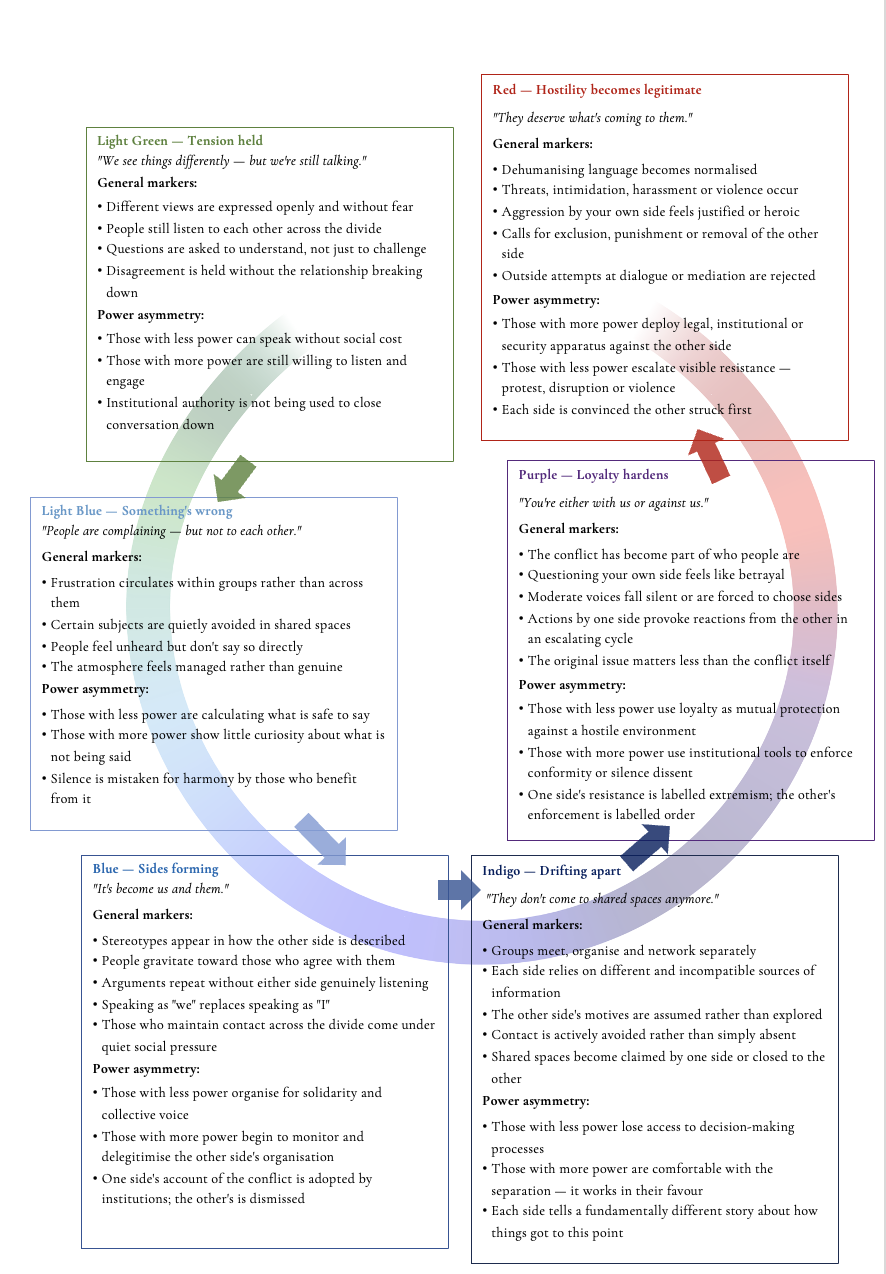
Light Green
Light Blue
Blue
Indigo
Purple
Red
Light Green – Contact maintained
The polarity exists and different views are visible. People are still in contact with each other and the tension can be held without the relationship breaking down.
Where power is unequal, those with less power are still able to speak and be heard, and those with more power are still willing to listen and engage rather than dismiss or deflect.
General markers:
- Conversation continues despite disagreement
Are the two sides still talking to each other? - Willingness to listen across the divide
Do the sides till listen to the views of the other side? - Different views are clearly expressed without risk of retaliation.
Can opposing views be expressed without fear or hesitation? - Questions are asked to understand the issue and each other
Do participants ask questions to understand? - People still meet and talk across the divide
Do different groups still mix with each other easily?
Asymmetric power markers
- Concerns raised by those with less power are taken seriously rather than reframed as problems of attitude or behaviour.
Can grievances be raised and are they acted upon or responded to? - Those with institutional power do not use that power to close down the conversation.
Are there spaces for conversations about problems with those in power? - Disagreement is not yet treated as disloyalty or deviance.
Do those in power tolerate disagreement?
A note on what this zone actually is
The Green zone is not a place without differences, power, or tension. It is not neutral ground, and it is not a state of harmony that exists naturally when nothing has gone wrong. It is something more specific and more fragile than that: a space where relationships are strong enough, trust is sufficient, and communication is healthy enough that differences can be held constructively rather than destructively.
Power exists here. Inequality exists here. Different people enter this space from different starting lines, with different histories, different privileges, and different vulnerabilities. Pretending otherwise — performing equality that does not exist — does not create safety. It creates frustration, and eventually mistrust. The Green zone is sustained not by the absence of these realities but by the willingness to acknowledge them honestly.
This zone is also not permanent. It requires continuous attention and active maintenance. The conditions that make it possible have to be built before they are needed — because once the conflict is up in flames, it is too late to start building them. Everything that follows in this tool — every intervention, every process, every thread of trust drawn on in the later zones — has its roots here, in what was or was not built while things were still going well.
Practitioner’s Stance
The work of the Green zone begins with yourself.
Before you can read the room, you need to be able to read your own position in it. You are not neutral — neutrality, in any meaningful sense, does not exist. You carry assumptions, experiences, values, and a particular lens through which you see what is happening. Your role, your rank, your institutional affiliation, your cultural background, your own history of inclusion or exclusion — all of these shape what you notice, whose discomfort you register first, whose account of a situation feels more natural to you. That is not a failing. It is the human condition. But if it goes unexamined, it will shape your practice in ways you cannot see or correct.
The discipline this zone requires is not neutrality but honest self-awareness — the continuous practice of questioning your own assumptions, noticing your own lens, and asking yourself what you might be missing because of where you stand. This is not a preliminary to the work. It is the work, from the first moment of contact.
Own your power without dominating. You have a role, an authority, a degree of institutional power. Pretending you do not — performing a false equality with those you are working with — does not create trust. It creates confusion and, often, resentment. People know when power exists and they know when it is being hidden from them. What creates trust is not the absence of power but its transparent, accountable use. Be willing to say: this is the decision I have made, and this is how I arrived at it. These are the constraints I am working with. This is what I know, and this is what I do not know. Transparency about your own thinking is one of the most powerful trust-building practices available to you — and it costs nothing except the willingness to be honest.
Be equally honest about what you do not know. In many institutional cultures, not knowing is experienced as weakness — something to be hidden behind authority or deflected with procedure. The participants in this work said something different: trust often grows precisely when a leader is willing to say I don’t know, or we don’t have the resources for that, rather than concealing uncertainty behind a performance of competence. Honesty about limitation is not weakness. It is the foundation of a relationship in which people feel they are being treated as capable of handling the truth.
Be curious about what forms of connection already exist in this group that you have not yet recognised as dialogue. Not every meaningful exchange happens through words. Shared activity — music, movement, making, building, cooking, play — can create and sustain the relational conditions that structured conversation alone cannot produce. Ask yourself: what is already happening here that I might be undervaluing? (See Dialogue Beyond Words in the introduction.)
Maintain the habit of the reflective pause — not only as a response to crisis but as a regular practice. Even in the Green zone, periodically ask: what lies beneath what I am seeing? What is being said — and what is not being said? What do I know about this group, and what am I assuming? The practitioner who asks these questions regularly in the Green zone will catch the first signs of Light Blue before they become invisible.
Building: The Proactive Work
The Green zone is where the foundation is laid. Everything that will be drawn on in the zones that follow — every thread of trust, every relationship that survives a crisis, every moment of connection that makes de-escalation possible — has its origin here. This is not metaphor. It is the structural logic of the tool. You cannot begin to create trust when everything is up in flames. You build it now, while things are still going well.
Recognise power rather than deny it.
Power structures exist even when they are not visible. Even in groups that appear equal, people enter with different positions, experiences, privileges, and forms of influence. The first step is to acknowledge this reality rather than pretend it does not exist. Pretending everyone is equal when they are not does not create equality — it creates a managed surface beneath which inequality continues to operate, now without the possibility of being named or addressed.
This does not mean making power the constant explicit subject of every conversation. It means being honest — with yourself and, where appropriate, with the group — about the reality of different starting lines. As one participant in this work put it: “You who hold the power, you also understand that we start from different starting lines.” That acknowledgement, offered simply and without drama, is more trust-building than any performance of equality.
Create transparency around decisions and processes.
People often resist not the decision itself but the absence of insight into the thinking behind it. When a leader makes their thought process visible — why are we doing this, how did I arrive at this decision, what constraints are we working with, how did we get from A to B — they are doing something that goes beyond good communication. They are treating people as capable of understanding complexity, worthy of honest engagement, and entitled to know how the power that affects them is being used. That is a profound form of respect, and it builds the kind of trust that survives difficulty.
Notice and strengthen what is already working.
In the Green zone, the practitioner’s primary orientation should not be toward problems but toward what is functioning well. Ask yourself: what have we done so well that people feel safe here? What relationships are strong? What forms of communication are healthy? What shared experiences have created trust? Identify those things, name them, and strengthen them deliberately. The Green zone exists because certain conditions are in place. Your job is to understand what those conditions are and to invest in them actively — not to wait for them to erode before paying attention.
This includes noticing and acknowledging positive interactions when they happen. A moment of genuine connection across a difference, a conversation that holds tension without breaking down, a young person who speaks honestly in a difficult moment — these are not incidental. They are evidence that the conditions are working. Name them. They become part of the group’s understanding of itself.
Build relationships and trust before they are needed.
Conflict, disagreement, and tension are not exceptional events — they are inevitable features of any group that contains real human beings with real differences. The question is not whether they will arrive but whether sufficient trust exists when they do. The relationships and trust built in the Green zone are the resources the group will draw on when things become difficult. They are the difference between a group that can hold tension and one that fractures under it.
This means investing in relationships deliberately and continuously — not as a response to emerging problems but as ordinary practice. Shared experiences, informal time, activities that create connection without agenda, moments of genuine encounter across difference — these are not luxuries or supplements to the real work. They are the real work, at this stage.
Establish the conditions for dialogue — including beyond words.
From the beginning, create a group culture in which different views can be expressed, questions can be asked, and disagreement does not break the relationship. This does not happen automatically — it is built, through the practitioner’s modelling, through the norms that are established early, through the repeated experience of difference being held rather than punished.
Include forms of connection that go beyond conversation. Shared physical and artistic activity — music, movement, making, building — creates relational conditions that structured dialogue cannot always reach. In youth work especially, these are not additions to the programme. They are often its most important elements. (See Dialogue Beyond Words in the introduction.)
Maintaining: The Continuous Work
Building the conditions is not enough. The Green zone requires continuous attention to sustain what has been built. It is not a stable state — it is a dynamic one, held in place by ongoing practice. The switch can come very fast. A group that appears settled can shift in a single conversation, a single incident, a single moment of exclusion that goes unnamed.
Read the room — always.
Even when things are going well, maintain the habit of attentiveness. Notice changes in energy, shifts in who is speaking and who has gone quiet, changes in the atmosphere of a space. Notice who is arriving late or leaving early, whose body language has shifted, which subjects are beginning to be avoided. The Green zone is identified less through words than through the quality of what is present — the ease of contact, the willingness to engage, the sense that the space is genuinely shared. When that quality begins to change, the change will be felt before it is visible. Learn to trust that feeling.
Resist the temptation to relax into apparent calm.
The practitioner who mistakes the absence of visible conflict for health is the most vulnerable to missing the transition to Light Blue. Managed calm — the performance of normality over unspoken tension — can look identical to genuine ease from the outside. The discipline is to keep asking: is this real ease, or is this managed calm? Is the silence comfortable, or is it the first sign that people have stopped trusting the space enough to speak honestly within it?
Maintain the reflective pause as a regular practice.
Return regularly to the question: what lies beneath what I am seeing? Not as a crisis response but as an orientation. In the Green zone this practice is easy to sustain and easy to neglect. Sustain it. It is the habit that will make the difference at the threshold to Light Blue — where the most important shift in the entire tool happens, and where it is most easily missed.
Support the conversations that are already happening.
Notice small moments where people across a difference engage genuinely — and acknowledge them, quietly, without over-directing. Your role at this stage is not to introduce new conversations but to support the ones that are already emerging. Facilitate connection. Allow things to unfold. Resist the urge to fix what is not yet broken — the practitioner’s anxiety can be more disruptive than the tension itself.
Stay attuned to power.
Even in the Green zone, power differentials are present and active. Continue to ask: whose voice is being heard, and whose is quiet? Who is comfortable in this space, and for whom does it require effort? Is the silence of some people ease or calculation? The asymmetry that drives escalation in later zones begins here, in the small, daily dynamics of who feels entitled to speak and who does not. Noticing it early, and responding to it — not dramatically, but consistently — is the most important preventive work available.
Ask yourself: what forms of connection already exist in this group that I have not yet recognised as dialogue?
Practitioner’s Dilemma
Owning power without creating hierarchy.
Youth workers and peace workers often feel deep discomfort with authority. The values that drew them to this work — participation, equality, empowerment — can make it difficult to acknowledge and exercise the power they actually hold. And yet the abdication of power does not create equality. It creates a vacuum that is filled by other, less visible forms of power — by the loudest voice, the most confident person, the existing social hierarchies of the group.
The dilemma is real and it does not resolve cleanly: taking responsibility creates safety but can create distance; stepping back creates participation but can create chaos. Neither pole is the answer. The practitioner navigates between them, consciously, case by case, asking at each moment: what does this group need from me right now — more structure or more freedom, more direction or more space?
Transparency is what makes this navigation trustworthy. When the practitioner is honest about the choices they are making and why — when they can say I am taking a decision here, and this is my reasoning — people can engage with the power rather than simply being subject to it. That is the difference between authority that builds trust and authority that erodes it.
This tension — between ownership of power and avoidance of hierarchy, between control and chaos — is a permanent feature of youth and peace work. It is not solved. It is practised. And the Green zone is where the practice begins.
Signs of Escalation
The following signals suggest that the zone is shifting and that Light Blue dynamics may already be forming beneath the surface:
- The atmosphere in shared spaces begins to feel slightly managed — people are a little more careful, a little more polished in how they interact.
- Certain subjects begin to be avoided by unspoken agreement — not dramatically, but noticeably, if you are paying attention.
- Some people are quieter than usual. Their quietness does not feel like ease.
- Conversations that were happening naturally across difference become slightly more effortful, slightly less spontaneous.
- You notice people gravitating toward those who agree with them in informal moments — choosing where to sit, who to walk with, who to speak to first.
- Someone says something to you privately that they have not said in the group. The gap between the private conversation and the public one has begun to open.
- You sense that the room is performing normality rather than inhabiting it. Trust that sense.
The most important thing about these signals: the move from Light Green to Light Blue frequently looks like improvement from the outside. The room is calmer. People are politer. Conversations flow more smoothly. A practitioner who reads surface atmosphere rather than depth will mistake this for progress. It is not. It is the first sign that people have stopped trusting the shared space enough to speak honestly within it.
When these signals appear, the approach shifts — from building and maintaining the conditions for contact, toward actively surfacing what has begun to go underground.
Important Note
The trust and relationships built in the Green zone are not a preliminary to the work of this tool — they are its foundation. Every intervention described in the zones that follow draws on what was or was not built here. The way back from Red, from Purple, from Indigo, runs through the connections that were established and maintained while things were still going well. This is the single most important structural truth in the entire tool: you cannot begin to build trust when everything is up in flames. Build it now. Here. Before the crisis. Before the polarisation. Before the intervention. Before outside actors become involved.
The Green zone is where the work begins — and where it is most easily neglected, because it does not feel urgent. That is the practitioner’s central challenge in this zone: to invest seriously in something whose value only becomes fully visible when it is tested.
The primary shifts between Light Green and Light Blue
From visible to hidden In Light Green, tension is present but held openly — different views are expressed, questions are asked, people still engage across the divide. In Light Blue, the tension goes underground. The same feelings that were being expressed directly begin to circulate privately, within groups rather than across them. This is perhaps the most fundamental shift: what was visible becomes concealed, and concealment itself becomes a strategy.
From discomfort to calculation In Light Green, people feel the tension but continue to engage despite it. Discomfort is present but not yet decisive. In Light Blue, a calculation has entered: is it worth saying this here, to these people? That calculation — however unconscious — marks a qualitative shift. People are no longer simply feeling their way through difference; they are beginning to manage it strategically. Self-censorship is the first sign of this shift.
From difference to distance In Light Green, difference is visible and held in relationship. People disagree but remain in genuine contact. In Light Blue, a small but significant distance opens — not yet structural, not yet organised, but felt. People begin to prefer the company of those who agree with them, not because they have made a decision to do so but because it is simply easier and safer. This preference, if unnoticed, quietly erodes the conditions for contact.
From tension held to tension displaced In Light Green, tension is held in the relationship itself — it lives between people who are still in contact. In Light Blue, that tension is displaced: it moves out of the shared space and into private conversations, complaints within groups, gossip about others. The relationship no longer carries the tension; it avoids it. This displacement is what makes Light Blue so deceptive — the shared space feels calmer, but the tension has not reduced. It has simply moved somewhere less visible.
From open atmosphere to managed atmosphere In Light Green, the atmosphere in a shared space reflects what is actually happening — tension is perceptible but real. In Light Blue, the atmosphere begins to be managed. People perform normality. Certain subjects are avoided by unspoken agreement. The gap between what the room looks like and what people are actually feeling begins to open. This gap is one of the most important things a practitioner needs to learn to read.
From relational risk to social risk In Light Green, the risk of expressing a view is primarily relational — someone might disagree, the conversation might become uncomfortable. In Light Blue, the risk has shifted toward the social — expressing a view might damage your standing, mark you as difficult, or align you with the wrong side in the eyes of your own group. This shift from relational to social risk is what begins to silence people, and it operates most powerfully on those with least social capital or security.
The most important and most commonly missed shift: The move from Light Green to Light Blue frequently looks like improvement from the outside. The room is calmer. People are politer. Conversations flow more smoothly. A practitioner who reads surface atmosphere rather than depth will mistake this for progress. In reality, the conditions for constructive engagement are quietly deteriorating. The practitioner’s most important skill at this threshold is the ability to distinguish genuine ease from managed calm.
The asymmetry at this transition: In power-asymmetric situations, the shift from Light Green to Light Blue happens faster and is harder to reverse. Those with less power reach the calculation point — is it worth saying this? — much sooner, because the social cost of speaking is higher for them. The silence that results is then read by those with more power as absence of concern, which removes any incentive for them to act. The asymmetry at this early stage quietly sets the trajectory for everything that follows.
When tension that was held openly begins to circulate privately, the conditions for constructive engagement are already quietly deteriorating. What looks like calm from the outside may be the first sign that people have stopped trusting the shared space enough to speak honestly within it.
Back to the top
An Overview of all the Zones