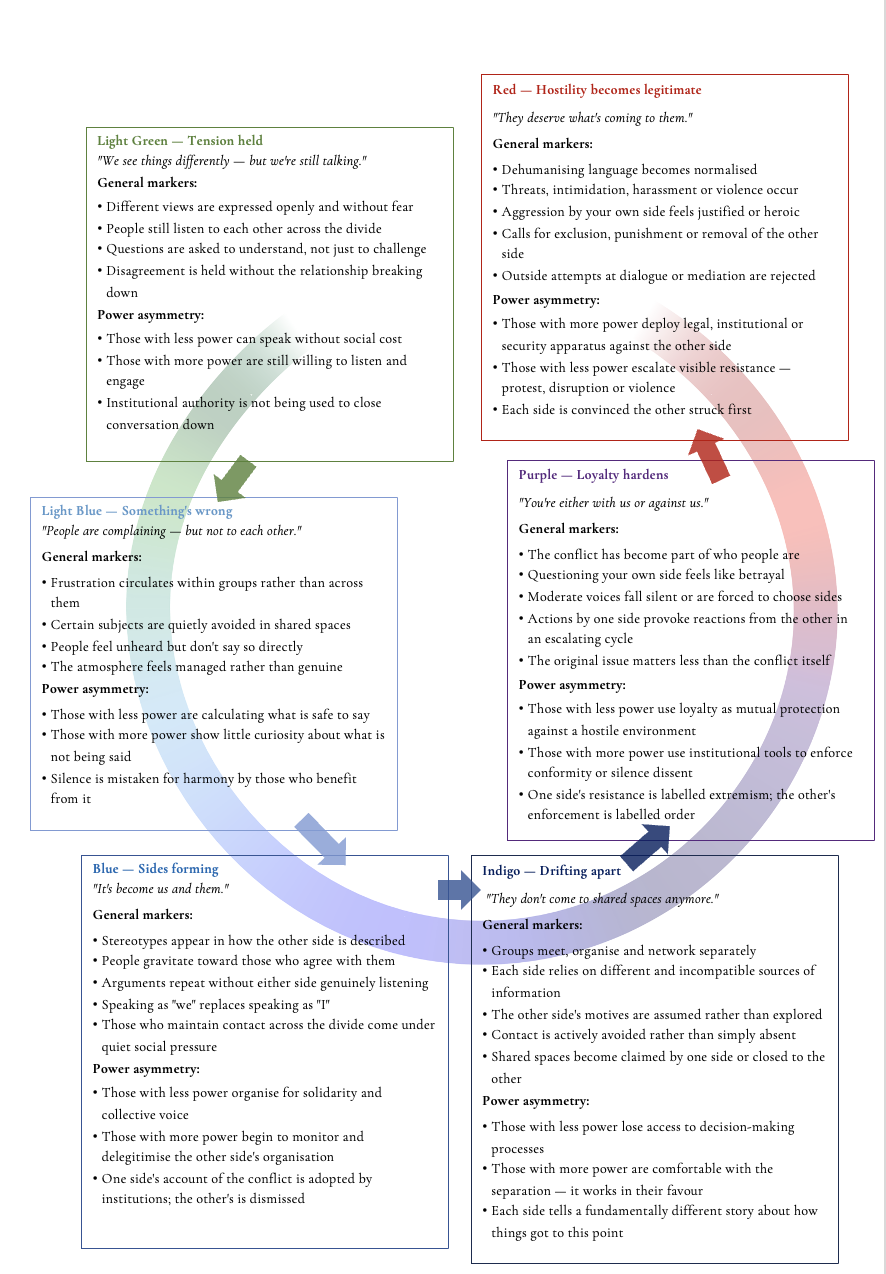
The Indigo Zone
“They don’t come to shared spaces anymore.”
Light Green
Light Blue
Blue
Indigo
Purple
Red
The primary shifts between Blue and Indigo
From dynamic to structural In Blue, clustering and side-taking is still a behaviour — people are choosing to gravitate toward their own group, but the infrastructure of separation is not yet fixed. In Indigo, the separation has become built in. Separate networks, separate information sources, separate spaces. What was a tendency is now a architecture. This is why the transition is so consequential — dismantling a structure requires far more effort than redirecting a tendency.
From contest to withdrawal Blue is characterised by argument and emotional debate — the sides are still engaging, even if badly. In Indigo, that engagement largely ceases. The energy shifts from contest to avoidance. This can look like calm from the outside, and is frequently misread as improvement. It is not. It is the calm of disengagement, not resolution.
From issue to worldview In Blue, the sides disagree about something. In Indigo, they increasingly inhabit different realities — different information sources, different accounts of history, different interpretations of the same events. This is the Bohm fragmentation becoming fully operational. You can no longer assume a shared factual basis for conversation. This makes dialogue qualitatively harder — you are not just bridging different opinions but different pictures of the world.
From social pressure to exclusion In Blue, crossing the divide carries social cost. In Indigo, the crossing itself becomes practically difficult — the bridges are gone or guarded. Individuals who might want to maintain contact across the divide find the structural conditions for doing so have eroded. Exclusion begins to operate not just through pressure but through absence of opportunity.
From visible to invisible power dynamics In Blue, power asymmetry is active and somewhat visible — the more powerful group monitors, delegitimises, controls narrative. In Indigo, the power asymmetry often becomes naturalised. The separation feels normal, even inevitable. The more powerful group no longer needs to act — the structure does the work for them. This is perhaps the most insidious shift in the whole model: oppression that requires no oppressor present.
The shift in the practitioner’s role In Blue, the practitioner could still work with the whole group as a reference point, using separate meetings as preparation for joint work. In Indigo, the whole group may no longer exist as a meaningful shared space. The practitioner is now working to rebuild conditions for contact that previously existed naturally. That is a fundamentally different task — more painstaking, more easily disrupted, and requiring more explicit structural thinking rather than just relational skill.
The most critical and commonly missed shift: The moment when individuals who bridge the divide — who still have relationships on both sides — come under sufficient pressure to choose. Once those bridge figures are lost, the last natural channels of communication close. Identifying and protecting bridge people is one of the most important and least discussed tasks at this stage.
One asymmetry worth flagging explicitly: In power-asymmetric situations, Indigo often looks like the less powerful group’s choice to separate — they stop engaging, stop attending shared spaces, stop participating in joint processes. From the more powerful group’s perspective this reads as withdrawal, sulking, or lack of commitment. The structural reasons for that withdrawal — exclusion from decision-making, loss of access, the futility of engaging in spaces that don’t hear them — are invisible to those who have never experienced them. The practitioner must hold that asymmetry clearly, or their attempt to rebuild contact will feel like a demand for compliance to the less powerful group.
Indigo – Groups Drift Apart
Contact between the groups becomes weaker. People mostly talk with their own side. What began as a difference of views has become a difference of worlds — separate networks, separate sources of information, separate accounts of reality. The divide is no longer just about the original issue; it has become structural.
Where power is unequal, this separation is rarely symmetrical: those with less power are often excluded from spaces and networks they did not choose to leave, while those with more power may experience the separation as natural, comfortable, or even unnoticed.
General markers:
- Separate meetings, events, and networks develop on each side.
Do the different groups now organise and meet separately rather than together? - Different and increasingly incompatible information sources are used and trusted. Are the groups relying on different sources of information that lead to contradictory pictures of reality?
- Loss of trust in the other side’s good faith.
Do people assume the other side has hidden or dishonest motives? - Active avoidance of dialogue rather than merely the absence of it.
Are people deliberately steering away from contact with the other side rather than simply not seeking it? - Institutional spaces that were once shared become claimed by one side or effectively closed to the other.
Are spaces, platforms, or institutions that once belonged to everyone now effectively controlled by one side? - Each side develops its own account of how the separation happened and who is responsible for it.
Do the two sides tell fundamentally different stories about how things got to this point?
Asymmetric power markers
- Those with less power lose access to decision-making processes, formally or informally.
Are certain groups being excluded from the conversations and decisions that affect them? - Those with more power no longer need to engage — the separation works in their favour.
Do those in authority seem comfortable with the growing distance rather than concerned by it?
Advice
Practitioner’s Stance
If you have reached this zone, your role has changed. Name that shift to yourself clearly. What was facilitation has become something closer to mediation. The skills required, the preparation needed, and the risks involved are all of a different order. This is not a failure of competence — it is a recognition of what the situation now requires.
The most important thing to say at the outset is this: do not try to handle this alone. Not because you are not skilled enough, but because no single person can hold the relationships, the awareness, and the process that this zone requires. The situation has become larger than one practitioner’s capacity — and recognising that clearly is itself an act of professional judgement, not personal failure.
And yet — your role does not end. This needs to be said as clearly as the first point, because the instinct when outside help arrives is either to hand over entirely or to keep doing what you were doing as if nothing had changed. Neither is right. What changes is your primary function. What remains is your relationship — with the young people, with the group, with the individuals on all sides who still know and trust you. That relationship is not a secondary resource. At this stage it may be the most important one available.
Multi-partiality remains your foundation — but it is harder to maintain here, because the pressure from each side to demonstrate loyalty is greater. Avoid moralising at all costs. Your empathy and non-judgement are not just values — they are the primary reason either side will continue to engage with you at all.
Know your own triggers. At this zone the conflict is likely touching identity, values, belonging, and possibly experiences of violence or deep injustice. You will have your own cultural history, your own non-negotiables, your own fear and bias. A youth worker dealing with hate speech directed at a community they feel connected to — by history, by identity, by experience — will feel that differently than a worker without that connection. Neither is wrong. But if you cannot notice your own reaction and work with it consciously, you can easily become part of the escalation rather than a brake on it. Self-awareness here is not a personal virtue. It is a professional requirement.
Support without flag-carrying. Perhaps the most important orientation for this zone can be stated simply: I am here for you, but I am not necessarily supporting your position. This distinction — between care for the person and endorsement of their stance — is what allows you to remain present with young people who are moving toward positions you find harmful or wrong. It is not easy. It requires you to separate the human being from the ideology, the young person from the group, the need beneath the behaviour from the behaviour itself. But it is the only stance that keeps the relational door open — and that door may matter more than anything else you can offer at this stage.
On the difference between support and agreement
In the Indigo zone, young people — and adults — are under intense pressure to demonstrate loyalty to their side. Anyone who does not fully endorse their position may be experienced as a threat or a betrayal. The practitioner who tries to remain present with someone in this position will feel that pressure directly.
The distinction that makes this possible is not neutrality — which, as we have noted throughout this tool, is neither achievable nor honest. It is something more specific: the ability to care genuinely for a person while holding a different view of their actions or position.
This is not a technique. It is a quality of relationship — one that has to have been built over time, through ordinary contact, through the young person’s experience of being seen and not judged, through the accumulation of small moments of trust. It cannot be improvised at crisis point.
What it looks like in practice: sitting with someone, cooking together, doing ordinary things alongside them. Not raising the difficult topic. Waiting. Allowing the young person to bring it up in their own time, when the trust is sufficient and the moment feels safe. And then — when that moment comes — being willing to stay in the conversation without flinching, without judging, and without pretending to agree with what you do not agree with.
The youth worker who can do this is offering something that no mediator, no specialist, and no institutional process can replicate. They are offering a relationship with a human being who has not given up on them. At the Indigo zone, that may be the most powerful intervention available.
Immediate Response
Do:
- Get help. This is the first and most important action at this stage. Identify what kind of support is needed — a more experienced colleague, a professional mediator, a youth police officer, a social worker, a community mediation service — and begin that process without delay. The earlier outside support is brought in, the more options remain available.
- Ask for consent. Before bringing in any outside person or process, ask the groups: “Is it okay if I invite someone here to help us have a conversation about what is happening?” You cannot force mediation. If people do not accept the person or the process, there will be no fruitful conversation. Consent is not a procedural nicety — it is a precondition for anything that follows.
- Consider a mediation team rather than a single mediator. It may be impossible to find one person trusted equally by both sides — particularly where the conflict involves identity, values, or experiences that are not shared across the divide. A team — one person with a relationship to one side, another with a relationship to the other — working together and comparing notes may be more effective and more credible than a single outside figure claiming impartiality.
- Signal clearly to each group that the situation is serious. This is a strategic move — it shifts the frame from business as usual to one that requires a conscious choice. Name what you are observing, carefully and without drama: “We are in a situation that is serious and that I think needs us to address it together. There is a risk that it moves further if we do not.”
- Begin a shuttle process. Meet with each group separately before any thought of joint meeting. There must be no surprises in any joint process that follows. In those separate meetings, seek out key figures — natural leaders, trusted individuals, those with relationships on both sides. Ask for their help. As noted in the Blue zone, asking for help is not weakness — it is a shift in the power dynamic that makes collaboration possible.
- Consider intra-group dialogue before inter-group dialogue. Before bringing the two sides together, work within each group to make room for internal difference. Not everyone in the group has to agree completely. Disagreement inside the group does not have to mean betrayal. When a group can hold internal complexity — when it begins to loosen its rigid identity from inside — the pressure on the inter-group divide begins to reduce. This step is easily skipped, and skipping it is a common source of premature joint conversations that harden rather than soften the conflict.
- Put the cat on the table — but carefully and with support. At this stage, the situation should not be softened too much in how it is named. People need to understand the seriousness of where things stand. But the naming must happen within a relationship of sufficient trust, with support structures in place, and without drama or accusation.
- Look beneath the surface. A young person who appears radicalised, aggressive, or hateful is showing you a symptom. The question is what is driving it. Ask yourself — and in time, ask them: what did this person need that they did not get? Beneath the position, the ideology, the group identity, there is almost always an unmet need: not feeling belonging, not feeling seen, lacking resources or supportive adults, needing somewhere meaningful to be. The youth worker’s task is to deconstruct backwards — to find the original need and work from there. The aim may not be to change the ideology immediately. It may first be to help the person manage their feelings, their aggression, their actions — and to restore their sense of being simply a young person with the right to support, belonging, and space to grow.
Don’t:
- Convene a joint meeting until each group has been thoroughly prepared, their grievances are clear, and there are no surprises. A premature joint meeting at this stage can cause rapid escalation toward Purple.
- Become a messenger — carrying positions, accusations, or provocations between groups. You carry understanding, not messages.
- Moralise or signal that one side’s behaviour is more legitimate than the other’s. Either side sensing your judgement will close the process down.
- Challenge group identity directly, particularly for those whose group membership represents protection, survival, or dignity. If people feel their identity is being questioned or dismantled, you become the other side. Your trust is gone. The task is not to move people out of their identity but to create enough safety that they can, in time, look beyond it voluntarily.
- Alert institutional authorities automatically or prematurely — a panicked systemic response can destroy the trust-based process you are building. Whether and when to involve statutory services depends on the institutional context and the specific risks involved. Use that judgement carefully, document it, and do not make that decision alone.
- Ignore your own safety. If a situation feels physically or psychologically unsafe, it probably is.
- Disappear when outside help arrives. Your relationship with the young people is not replaced by the specialist — it is the relational ground on which the specialist process depends.
Dialogue Beyond Words
At the Indigo zone, dialogue beyond words takes on a particular character. The trust-building that structured conversation cannot yet achieve may be possible through shared ordinary activity — sitting together, cooking, doing things alongside each other without agenda. This is not a warm-up for the real work. For many young people at this stage, it is the real work. The youth worker who can simply be present — without pushing, without agenda, without requiring the young person to perform openness — is creating the conditions in which the young person may eventually choose to speak.
Ask yourself: what forms of connection already exist in this group that I have not yet recognised as dialogue?
Longer Term
- If both groups are willing to engage, move toward a structured mediation-style dialogue. This should include: agreed ground rules, space for each side to make a statement, joint exploration of underlying causes and effects, and a generative phase aimed at agreement or at least shared understanding.
- Prepare all participants separately before including them in any joint process. This includes bystanders — those not aligned with either faction — who are part of the field and whose eventual inclusion matters, but who need as much preparation as the factions themselves.
- If a group refuses to engage and actively chooses escalation, be honest with them: the situation will need to be handled by more specialised people. This is not a threat — it is an accurate account of what happens next. Name it calmly and without drama.
- Think creatively about what might create new shared ground. Where a conflict has become entrenched and one or both sides have little incentive to engage, sometimes what is needed is not a better dialogue process but a new shared challenge — a project, an activity, a problem that requires both sides to work together toward something neither can achieve alone. This is a negotiation and mediation concept: when the existing cake is the subject of the argument, bring another cake to the table. It requires creativity and resource, but it can shift a dynamic that nothing else has been able to move.
- Continue long-term relationship work with individuals who are moving toward radicalisation or strongly hardened positions. This work is slow, ordinary, and often invisible. It involves spending time together in everyday activity — not to raise the difficult topic, but to maintain the relationship until the young person is ready to raise it themselves. The opening, when it comes, will be small. Be ready for it without forcing it.
- Build in regular reflection — your own and with a trusted colleague or supervisor. At this stage the practitioner is carrying significant weight, and without reflective space, judgement deteriorates.
- Watch for signs of movement toward Purple: moral language hardening, moderates falling silent, individuals being pressured to choose sides. If those signs appear, the window for Indigo-level work is closing.
Conditions
- The practitioner retains enough relational trust with at least some individuals in each group to maintain a presence — however quiet.
- Outside support has been identified and is accessible — mediators, youth police, social workers, community mediation services. The practitioner knows what exists and how to reach it before they need it.
- Consent to outside involvement has been sought and at least provisionally given by key figures in each group.
- There is enough time and institutional space to conduct a proper shuttle process. Rushed mediation at this stage causes more harm than good.
- The institutional context allows for a degree of confidentiality — people can speak honestly without fear that what they say will be used against them bureaucratically or legally.
- Power differentials are clearly visible to the practitioner — particularly the risk that the less powerful group’s withdrawal is being read as aggression or unreasonableness rather than as a rational response to exclusion.
- The practitioner has regular supervision and collegial support. The psychological weight of this work is significant and should not be carried alone.
- When signs of violence, hate speech, or fascination with violence appear, other systems must become involved — police, social workers, mediation services, crime prevention structures. In some contexts this happens through established referral pathways; in others the practitioner must actively build those connections. Know which situation you are in. Involve law enforcement thoughtfully — the quality of that contact matters enormously. A youth police officer skilled at listening and building trust with young people is a very different resource from a standard law enforcement response. Where possible, know the individuals as well as the institutions.
- The practitioner’s own safety is assured, or can be managed.
On knowing your limits — and staying anyway
[Collapsible section]
There is a tension at the heart of this zone that deserves to be named directly.
On one hand, the situation has moved beyond what a regular practitioner should be expected to manage alone. Seeking specialist help is not optional — it is a professional obligation.
On the other hand, the practitioner’s continued presence is irreplaceable. The relationship they have built — with the young person, with the group, over time, through ordinary contact — is not something a mediator or social worker or police officer can arrive and replicate. It exists because it was built slowly, and it matters precisely because it has survived this far.
These two things are not in contradiction. They require different actions simultaneously: bringing in the right people, and staying present yourself. Neither replaces the other.
The practitioner who disappears when the specialist arrives has abandoned the young people at the moment they most need continuity. The practitioner who refuses to bring in help because they feel responsible has placed their own sense of ownership above the young person’s need for the right kind of support.
The skill — and it is a skill, not an instinct — is to hold both at once: to know what you cannot do, and to keep doing what only you can do.
Signs of Escalation
The following signals suggest that the zone is shifting and that Purple-zone dynamics may already be forming:
- Moral language is hardening. The conflict is beginning to be described not as a disagreement about issues but as a matter of right and wrong, good and evil.
- Moderate voices — those who might naturally seek dialogue or question their own side — are falling silent or disappearing from view. Their silence is a signal, not a relief.
- Individuals are being pressured to choose sides. Those who maintain contact across the divide are being questioned, challenged, or treated with suspicion by their own group.
- The original issue matters less than the conflict itself. People are no longer primarily angry about what started this — they are angry about the conflict, about the other side, about what has been done and not done. The grievance has become a cause.
- Actions by one side are beginning to provoke deliberate reactions from the other. The dynamic is no longer drift — it is starting to feed itself.
- Be alert to digital amplification. At this stage, online spaces — social media, group messaging, external platforms — may be actively fuelling the hardening of positions. External actors, wider political narratives, and algorithmic amplification can accelerate movement into Purple far faster than face-to-face dynamics would suggest. What appears manageable in the room may be being overwhelmed by what is happening outside it.
When these signals appear, the tools available to the regular practitioner are reaching their limit. The question of specialist involvement is no longer a future consideration — it is urgent.
Practitioner’s Dilemma
Two dilemmas surface at this zone that the tool cannot resolve — and that practitioners should not attempt to resolve prematurely.
The structural beneficiary dilemma: Some conflicts persist not because no one wants them resolved but because someone benefits from their continuation. Where one side holds structural power and that power is maintained by the existence of the divide, the motivation to engage in genuine dialogue may simply not be present. No amount of skilled facilitation can create motivation that structurally does not exist. The practitioner must name this dynamic honestly — to themselves, and where appropriate to decision-makers — and ask the harder question: what would need to change structurally for genuine engagement to become possible? And if the answer is: nothing short of a shift in power or resources — what then? This question has no clean answer. But failing to ask it produces interventions that address the symptom while leaving the cause entirely intact.
The waiting dilemma: Connected to this is a question that practitioners rarely feel permitted to ask openly: is there sometimes a point at which the conflict needs to become more painful before the motivation for change exists? Not as a strategy — no practitioner should manufacture crisis — but as an honest recognition that some conflicts do not move until the cost of continuing them becomes higher than the cost of engaging with them. This is a difficult and uncomfortable thought. It does not mean doing nothing. It means being honest about what is and is not within the practitioner’s power to shift, and focusing energy where genuine leverage exists — in relationships, in individual contact, in the slow work of keeping doors open — rather than in processes that the situation is not yet ready to support.
These dilemmas will reach their most acute form in the Purple zone.
Important Note
If factions are not brought into structured contact at this stage, identity and loyalty begin to fuse with the conflict itself. What could still be addressed as a dispute about issues becomes a dispute about who people are — and that is a fundamentally different and harder problem to reach.
The primary shifts between Indigo and Purple
From separation to fusion In Indigo, the group identity is a container for the conflict — people organise around their side because it feels safer or more effective. In Purple, the conflict becomes the identity. This is the crucial difference. In Indigo you can still, in principle, separate a person from their group position. In Purple, challenging someone’s position in the conflict feels like an attack on who they are. That makes every intervention exponentially more delicate.
From grievance to mission In Indigo, people are angry about something. In Purple, they have a cause. The shift from grievance to mission changes the psychological structure of the conflict entirely — missions are not resolved by addressing grievances, because the mission has taken on a life and meaning beyond the original complaint. The original issue becomes less important than the conflict itself.
From social cost to moral obligation In Indigo, crossing the divide carries social cost — people avoid it because it is uncomfortable or risky. In Purple, crossing the divide is not just costly but wrong. It is experienced as betrayal, weakness, or complicity with the enemy. This is a profound shift because it means the internal moderating voices — the people who might naturally seek dialogue — are now silenced not by fear alone but by genuine moral pressure from within their own group.
From avoidance to provocation Indigo is largely passive — groups drift apart, avoid contact, stop engaging. Purple introduces an active, outward energy. Actions are taken specifically to provoke a response from the other side. This is the beginning of the escalation cycle that can move very rapidly toward Red. Each provocation justifies the next reaction, and each reaction justifies the next provocation. The cycle becomes self-fuelling and increasingly difficult to interrupt from outside.
From manageable complexity to systemic complexity In Indigo, a skilled practitioner with mediation experience can still hold the situation. In Purple, the conflict has typically generated its own ecosystem — internal enforcers of loyalty, narratives that have spread beyond the immediate group, possibly external actors or influences that feed the dynamic. The practitioner is no longer dealing with a contained situation but with a system that has its own momentum.
Back to the top
An Overview of all the Zones