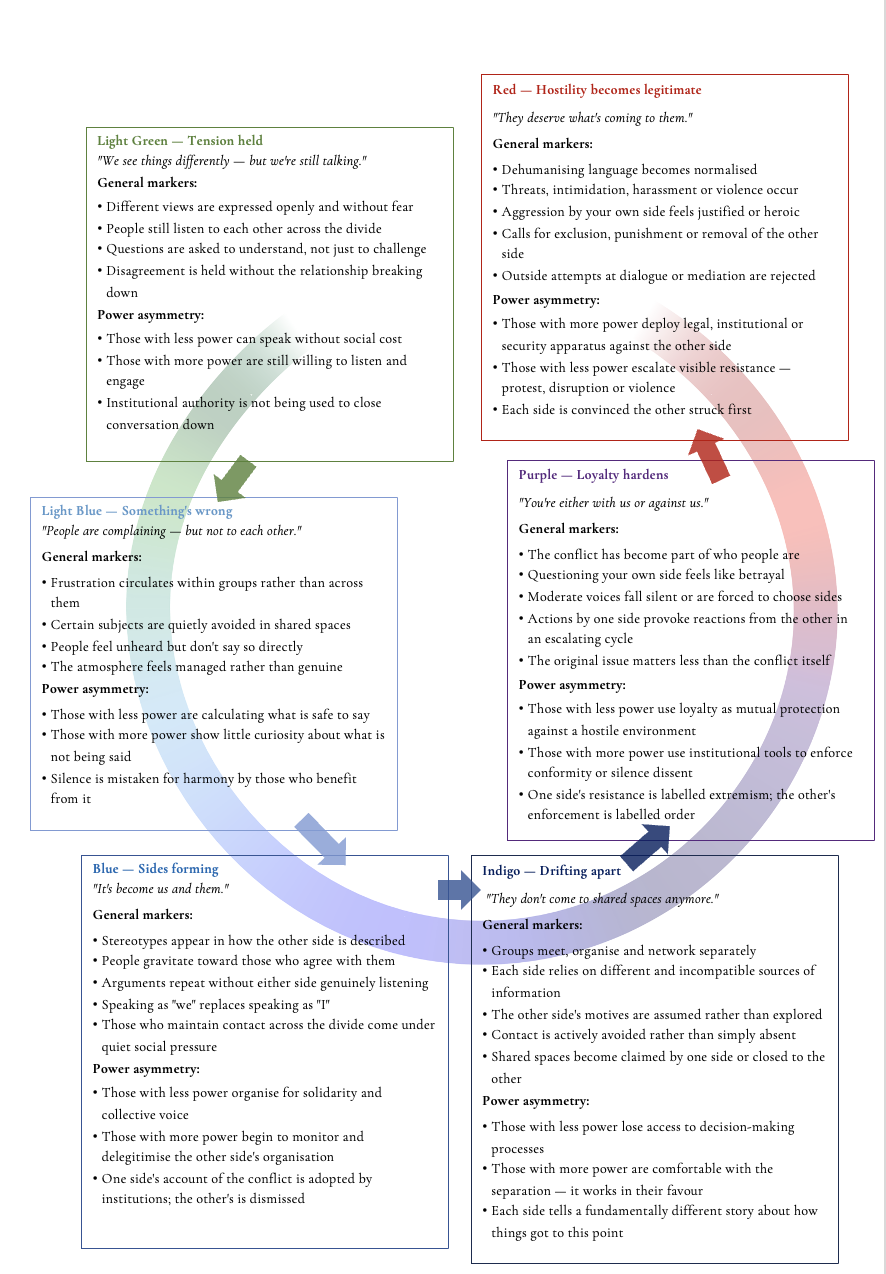
The Light Blue Zone
“We see things differently — but we’re still talking.”
Light Green
Light Blue
Blue
Indigo
Purple
Red
The primary shifts between Light Green and Light Blue
From visible to hidden In Light Green, tension is present but held openly — different views are expressed, questions are asked, people still engage across the divide. In Light Blue, the tension goes underground. The same feelings that were being expressed directly begin to circulate privately, within groups rather than across them. This is perhaps the most fundamental shift: what was visible becomes concealed, and concealment itself becomes a strategy.
From discomfort to calculation In Light Green, people feel the tension but continue to engage despite it. Discomfort is present but not yet decisive. In Light Blue, a calculation has entered: is it worth saying this here, to these people? That calculation — however unconscious — marks a qualitative shift. People are no longer simply feeling their way through difference; they are beginning to manage it strategically. Self-censorship is the first sign of this shift.
From difference to distance In Light Green, difference is visible and held in relationship. People disagree but remain in genuine contact. In Light Blue, a small but significant distance opens — not yet structural, not yet organised, but felt. People begin to prefer the company of those who agree with them, not because they have made a decision to do so but because it is simply easier and safer. This preference, if unnoticed, quietly erodes the conditions for contact.
From tension held to tension displaced In Light Green, tension is held in the relationship itself — it lives between people who are still in contact. In Light Blue, that tension is displaced: it moves out of the shared space and into private conversations, complaints within groups, gossip about others. The relationship no longer carries the tension; it avoids it. This displacement is what makes Light Blue so deceptive — the shared space feels calmer, but the tension has not reduced. It has simply moved somewhere less visible.
From open atmosphere to managed atmosphere In Light Green, the atmosphere in a shared space reflects what is actually happening — tension is perceptible but real. In Light Blue, the atmosphere begins to be managed. People perform normality. Certain subjects are avoided by unspoken agreement. The gap between what the room looks like and what people are actually feeling begins to open. This gap is one of the most important things a practitioner needs to learn to read.
From relational risk to social risk In Light Green, the risk of expressing a view is primarily relational — someone might disagree, the conversation might become uncomfortable. In Light Blue, the risk has shifted toward the social — expressing a view might damage your standing, mark you as difficult, or align you with the wrong side in the eyes of your own group. This shift from relational to social risk is what begins to silence people, and it operates most powerfully on those with least social capital or security.
The most important and most commonly missed shift: The move from Light Green to Light Blue frequently looks like improvement from the outside. The room is calmer. People are politer. Conversations flow more smoothly. A practitioner who reads surface atmosphere rather than depth will mistake this for progress. In reality, the conditions for constructive engagement are quietly deteriorating. The practitioner’s most important skill at this threshold is the ability to distinguish genuine ease from managed calm.
The asymmetry at this transition: In power-asymmetric situations, the shift from Light Green to Light Blue happens faster and is harder to reverse. Those with less power reach the calculation point — is it worth saying this? — much sooner, because the social cost of speaking is higher for them. The silence that results is then read by those with more power as absence of concern, which removes any incentive for them to act. The asymmetry at this early stage quietly sets the trajectory for everything that follows.
When tension that was held openly begins to circulate privately, the conditions for constructive engagement are already quietly deteriorating. What looks like calm from the outside may be the first sign that people have stopped trusting the shared space enough to speak honestly within it.
Light Blue – Unspoken tension
People feel that something is wrong, but the issue is mostly discussed within groups rather than across the divide. The conversation that needs to happen is being avoided or displaced.
Where power is unequal, those with less power have begun to calculate the social cost of speaking openly and have started to withdraw from direct engagement. Those with more power may be unaware of the tension or may be privately aware but comfortable leaving it unaddressed.
General markers:
- Complaints circulate within the group rather than across the divide.
Do you notice groups complaining about others? - Gossip, frustration, or low-level grumbling replaces direct conversation Indirect criticism replaces open disagreement
Are people speaking about others rather than directly to them? - A feeling that “no one is listening” or that speaking up changes nothing.
Do you hear or sense that people don’t feel heard or taken seriously? - People still meet and interact, but certain subjects are avoided
Do you sense that people are avoiding certain subjects?
Asymmetric power markers
- Those with more power show little curiosity about what is not being said.
Are those in authority assuming the absence of complaint means the absence of a problem? - Those with less power begin to self-censor, testing what is safe to say.
Are some people visibly cautious about what they say — watching reactions before committing to a view? - The silence is mistaken for harmony by those who benefit from it.
Who is comfortable with the current silence — and does their comfort depend on not looking too closely?
Advice
Practitioner’s Stance
Empathy and presence are not just values here — they are practical tools. But presence at this stage means something active: deliberately seeking out what is not being said. Who is quieter than usual? Who leaves early, or arrives late? Whose body language contradicts their words? Notice your own discomfort as you sense the shift — that discomfort is information, not a problem to be managed. Be honest with yourself about whether you are avoiding the tension too.
Go further than observation. When you notice differing opinions or a change in atmosphere, resist the temptation to read it as normal variation. Ask yourself the deeper question: what is driving this? Are these surface differences, or do they point toward something more structural — unmet needs, unequal power, accumulated grievance? Curiosity about the root is as important as sensitivity to the surface.
Immediate Response
Do:
- Ask yourself continuously: do people feel safe enough to say what is really going on? — rather than simply: has anyone started arguing yet? The absence of open conflict is not evidence that everything is fine.
- Name what you are noticing, carefully and without drama. “I have a sense that something is sitting unspoken in the room. Am I reading that right?” This is what one group of practitioners called “putting the cat on the table” — naming the issue that everyone already knows is there. The earlier this happens, the easier the tension is to address.
- Create small, lower-stakes opportunities for concerns to surface — a brief check-in, an end-of-session reflection, an informal conversation.
- Consider temporarily working in smaller or more homogenous groups where people may feel safer voicing what they hesitate to say in the full group.
- Assist people in naming emotions that are present but unspoken — give language to what is in the room.
- Connect individually with those you notice withdrawing or showing signs of frustration — and listen without immediately problem-solving.
- Ensure that everyone has an opportunity to contribute. Tensions escalate when people feel unheard, invisible or ignored. Pay particular attention to voices that are becoming quieter.
Don’t:
- Mistake silence for harmony. The absence of open complaint is not evidence that everything is fine.
- Privatise what is a collective issue. When individuals share frustrations with you, hold that as group information, not personal confession.
- Create sub-group structures that outlast the immediate need — you may inadvertently accelerate the formation of sides.
- Act before people are ready to speak. Ask yourself: will raising this now open things up, or drive things further underground?
- Ignore the tension because addressing it feels risky or premature. At this stage, early action is almost always better than waiting.
- Allow the managed calm of this zone to feel acceptable. When division begins to feel familiar — when the unspoken arrangement becomes comfortable for the group, and perhaps for you — it has already begun to solidify. The goal is not comfort. The goal is maintained connection.
Longer Term
- Establish regular, informal reflection spaces — “How has this week been? How have you experienced the climate in the group?” — so that voicing concerns becomes normal rather than exceptional.
- When you connect with withdrawing individuals, listen fully — but then ask yourself how what you are hearing reflects the group as a whole. Bring it back to the collective level.
- Begin to map the tension: who is uncomfortable, around what, and in relation to whom? This is diagnostic work, not gossip.
- Watch for the markers of Blue — stereotype language, alliance formation, repetitive arguments. Their appearance signals that the window for Light Blue intervention is closing.
- Be aware that unspoken tension rarely disappears — it often migrates to digital spaces the practitioner cannot observe. The silence in the room may reflect an active conversation happening elsewhere. If you sense this is occurring, find indirect ways to acknowledge it without forcing the conversation prematurely into the open.
Conditions
- The practitioner has a role legitimate enough to ask uncomfortable questions without it feeling like interrogation or surveillance.
- There are existing informal structures where feelings can surface — or the practitioner can create them without it seeming alarming.
- The group has some prior experience of being heard, so that voicing concern does not feel futile or dangerous.
- Power differentials within the group are not so stark that speaking up carries serious personal risk. Where they are, the practitioner must address that before expecting open expression.
- Before creating a shared space for difficult conversation, assess whether equal psychological safety actually exists for all participants. If some people’s identities, dignity or sense of belonging are already under pressure, the conditions for open dialogue may not yet exist equally for everyone in the room.
- The practitioner is trusted — at least provisionally — by more than one side of the emerging divide.
Signs of Escalation
The following signals suggest that the zone is shifting and that Blue-zone dynamics may already be forming beneath the surface:
- Conversations begin to sort themselves — people are choosing where to sit, who to address, whose contributions to engage with.
- The language of “us” and “them” appears, even quietly or humorously.
- Certain people stop contributing to whole-group conversations but remain animated in smaller clusters.
- You notice that some people are consistently more comfortable than others — and that those who are comfortable show little curiosity about those who are not.
- Attempts to name the tension are deflected, minimised, or met with performed surprise.
- The atmosphere feels increasingly managed — people are performing normality rather than inhabiting it.
When these signals appear, the window for Light Blue intervention is closing. The approach required is shifting from creating space for unspoken tension to surface, toward the more deliberate work of the Blue zone.
Practitioner’s Dilemma
One question surfaces at this zone that the tool cannot resolve — and that practitioners should not attempt to resolve prematurely.
Some tensions involve not just differing opinions but fundamental questions of identity, dignity and human rights. When this is the case, participants do not experience the conversation symmetrically. There is a meaningful difference between being challenged and having your existence questioned. Not all discomfort is equal.
This raises a dilemma that will intensify in the zones ahead: should some things be treated as non-negotiable — beyond the reach of dialogue and balancing? Or does treating issues as non-negotiable risk pushing the tension underground, where it may harden without anyone being able to reach it?
Neither answer is cost-free. The practitioner who imposes a non-negotiable frame may silence a tension without resolving it. The practitioner who treats everything as open to dialogue may expose vulnerable participants to harm in the name of process.
This dilemma has no clean resolution. What it requires is conscious, honest judgement — case by case, person by person — about what this particular group, in this particular moment, can actually hold.
Important Note
If unspoken tension is not surfaced at this stage, the conditions for open sides to form are already being laid.
The primary shifts between Light Blue and Blue
From private to structural In Light Blue, tension lives in individual experience — people feel something is wrong but carry it privately or within their immediate circle. In Blue, that private feeling has found collective form. Groups have begun to organise around it. The tension is no longer just felt; it has shape and membership. This is a qualitative shift, not just an intensification.
From avoidance to contest Light Blue is characterised by withdrawal — people stop saying things. Blue is characterised by assertion — people start saying we. The energy shifts from inward to outward. Silence gives way to argument, but argument that hardens rather than explores.
From relational to identity In Light Blue, the tension is about an issue. In Blue, the issue is becoming attached to who people are. This is the beginning of the identity fusion that fully crystallises in Purple. The stakes rise significantly — because now engaging with the other side’s view feels like a threat to self, not just a disagreement.
From recoverable to effortful Light Blue can be addressed by relatively light-touch facilitation — creating space, naming what is unspoken. Blue requires more deliberate effort because the structural conditions for further escalation are now in place. Sides exist. Crossing them costs something.
The most dangerous shift — and the most commonly missed: The practitioner’s role changes fundamentally. In Light Blue they could work with the whole group relatively naturally. In Blue, approaching the whole group as if it were still whole is itself a mistake — it may be read by one or both sides as naivety or bias. The practitioner must now consciously manage their relationship with each side, not just the room.
One critical asymmetry to flag: In power-asymmetric situations, the Blue zone often looks very different depending on which side you observe first. The less powerful group’s solidarity looks like escalation. The more powerful group’s defensive organisation is often invisible because it happens through existing structures. A practitioner who only sees the visible side of the organising will systematically misread the situation.
Back to the top
An Overview of all the Zones