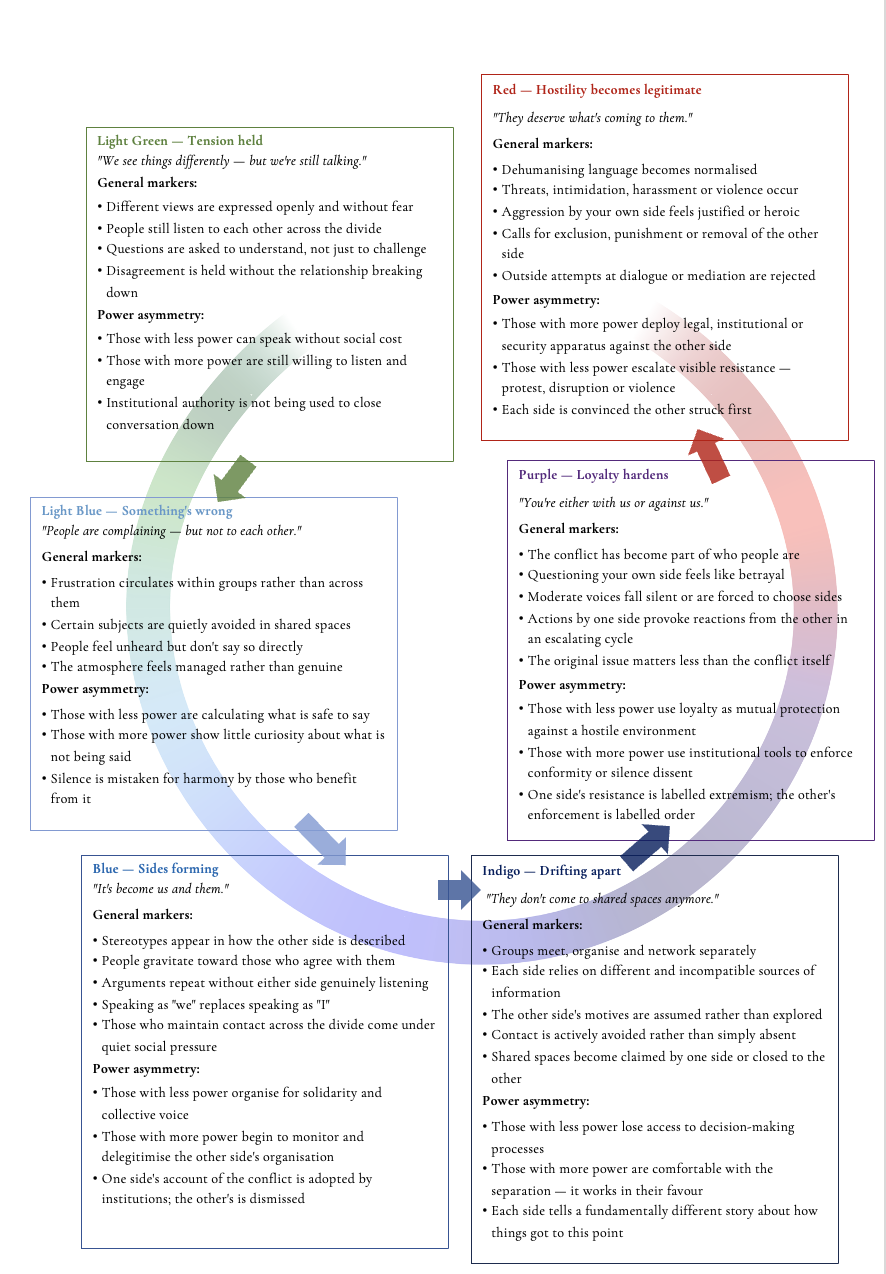
The Purple Zone
You’re either with us or against us.”
Light Green
Light Blue
Blue
Indigo
Purple
Red
The primary shifts between Indigo and Purple
From separation to fusion In Indigo, the group identity is a container for the conflict — people organise around their side because it feels safer or more effective. In Purple, the conflict becomes the identity. This is the crucial difference. In Indigo you can still, in principle, separate a person from their group position. In Purple, challenging someone’s position in the conflict feels like an attack on who they are. That makes every intervention exponentially more delicate.
From grievance to mission In Indigo, people are angry about something. In Purple, they have a cause. The shift from grievance to mission changes the psychological structure of the conflict entirely — missions are not resolved by addressing grievances, because the mission has taken on a life and meaning beyond the original complaint. The original issue becomes less important than the conflict itself.
From social cost to moral obligation In Indigo, crossing the divide carries social cost — people avoid it because it is uncomfortable or risky. In Purple, crossing the divide is not just costly but wrong. It is experienced as betrayal, weakness, or complicity with the enemy. This is a profound shift because it means the internal moderating voices — the people who might naturally seek dialogue — are now silenced not by fear alone but by genuine moral pressure from within their own group.
From avoidance to provocation Indigo is largely passive — groups drift apart, avoid contact, stop engaging. Purple introduces an active, outward energy. Actions are taken specifically to provoke a response from the other side. This is the beginning of the escalation cycle that can move very rapidly toward Red. Each provocation justifies the next reaction, and each reaction justifies the next provocation. The cycle becomes self-fuelling and increasingly difficult to interrupt from outside.
From manageable complexity to systemic complexity In Indigo, a skilled practitioner with mediation experience can still hold the situation. In Purple, the conflict has typically generated its own ecosystem — internal enforcers of loyalty, narratives that have spread beyond the immediate group, possibly external actors or influences that feed the dynamic. The practitioner is no longer dealing with a contained situation but with a system that has its own momentum.
Purple – Loyalty Hardens
The conflict becomes part of identity. People feel they must defend their side not merely because they believe they are right, but because belonging itself is now at stake. Questioning your own side feels like betrayal; engaging with the other side feels like weakness or complicity. Where power is unequal, this dynamic operates differently on each side: for those with less power, loyalty hardens as a form of protection and survival — the group is a shield. For those with more power, loyalty hardens as a form of preservation — dissent within the group threatens the coherence of the dominant position.
General markers:
Strong moral language frames the conflict as a matter of right and wrong rather than competing interests.
Are people describing the conflict in terms of good and evil rather than differing needs or perspectives
-
Internal criticism becomes difficult or dangerous — conformity is expected.
Is it safe for people to question or disagree with their own side’s position?
- Crossing the divide is seen as betrayal and may carry serious social cost.
Are people who maintain contact with or show understanding toward the other side treated as disloyal? - Actions by one side provoke reactions from the other in an escalating cycle.
Does each hostile act by one side trigger a hostile response from the other? - Moderates on both sides come under pressure and begin to fall silent or take sides.
Are the voices calling for dialogue or compromise becoming quieter or disappearing altogether?
Asymmetric power markers
- Those with less power use loyalty as mutual protection against a hostile environment.
Is solidarity among the less powerful group a means of survival rather than merely a political choice? - Those with more power begin to use institutional tools to enforce conformity or silence dissent.
Are authorities using formal mechanisms — rules, procedures, sanctions — to suppress or punish dissenting voices? - The original issue becomes less important than the conflict itself. Has the conflict taken on a life of its own, so that resolving the original grievance would no longer be enough to restore peace?
Advice
Practitioner’s Stance
Purple is a structural description of what is commonly called radicalisation — and it applies to both sides of a power-asymmetric conflict. The activist or less powerful group hardens into a cause; the authority or more powerful group hardens into a security posture. Each reads the other’s hardening as confirmation of their own. This mutual radicalisation is undertheorised in most frameworks and frequently missed by institutions that focus exclusively on the behaviour of the less powerful group. One of the purposes of this tool at this stage is to function as a risk analysis instrument — giving practitioners an evidence-based framework to challenge one-sided institutional responses that will accelerate rather than contain escalation.
If you are a regular youth worker or peace worker, name clearly to yourself what this zone requires: your role has shifted again, and shifted significantly. Direct intervention in the conflict is no longer your primary task. You are not the person who will resolve this. Accepting that clearly — without self-reproach — is the first professional act this zone demands.
And yet your role does not end. What remains is perhaps the most important thing you have ever offered: your relationship. The continuity of your presence. The fact that you have not given up, have not taken sides, have not disappeared. At Purple, when almost every other relational structure is sorting itself into camps, a practitioner who remains genuinely present — without agenda, without judgement, without flag — is offering something that no specialist can replicate and no process can manufacture.
Support without flag-carrying is the orientation that makes this possible — and at Purple it is under its greatest pressure. The young people you work with will want you to endorse their position. Their group will read your continued presence with them as implicit support for their cause. You will feel the pull to demonstrate loyalty, to prove you are on their side, to signal that you understand why they are doing what they are doing. You can understand — and you must understand — without endorsing. I am here for you. I am not here for this.
That distinction requires, at this stage, the deepest level of self-awareness the tool has asked of you. Know your own triggers. Know your own fear, your own cultural history, your own non-negotiables. The practitioner who cannot hold that self-knowledge will be absorbed into the conflict rather than remaining alongside it.
Multi-partiality is now extremely difficult to maintain — trust itself has become a loyalty marker, and being seen to engage with the other side may cost you access to one or both groups. Work quietly and carefully. Avoid public gestures that can be read as taking sides.
Be honest with yourself about the institutional pressures you are under. In some contexts practitioners are instructed to cease contact with groups that have been labelled radical or dangerous. Understand that such instructions, however well intentioned, may represent a Purple-zone move by the institution itself — a hardening of position that mirrors the dynamic it is trying to manage. If you face such instructions, use this tool as a risk analysis framework to articulate clearly what the consequences of cutting contact are likely to be. Seek support from colleagues, supervisors, or your professional body.
Document everything — what you observe, what you are told, what decisions you make and why, and what instructions you receive from above.
On remaining present when everything pulls you away
There is a particular kind of loneliness in the practitioner’s position at Purple. The conflict has sorted almost everyone into sides. The institutional pressure may be to withdraw. The groups themselves may be testing your loyalty. And yet the work — the real work — is precisely to remain.
What does remaining look like here? It rarely looks like facilitated dialogue. It looks more like: showing up. Sitting with someone. Cooking together. Listening without agenda. Being the person who is still there, still curious, still not judging, even now.
The dialogue beyond words principle — introduced earlier in this tool — reaches its most human expression at this stage. Not as a structured activity, not as a designed intervention, but as the simple fact of shared presence. A practitioner who can sit with a young person who is moving toward something dangerous, and remain warm, remain curious, remain genuinely interested in who that person is beneath the position they have adopted — that practitioner is doing something profound.
It may not look like much from the outside. It will not appear in an intervention report. But it may be the thread that, later, allows that young person to find their way back.
Ask yourself: am I still showing up — not to change anything, but to remain in relationship?
Immediate Response
Do:
- Maintain contact wherever possible. Breaking contact at this stage can make any further intervention extremely difficult or impossible — and removes the last relational bridge between the group and constructive engagement.
- Prioritise safety. If individuals or groups exhibiting Purple markers are part of shared activities, set clear and consistent boundaries that protect other participants from intimidation or recruitment. If they insist on participation, monitor that participation closely and without apology.
- Identify any natural leaders or key figures and focus relational energy there. Leaders are often the most viable entry point for negotiating next steps toward a structured process.
- Identify individuals within the group who may still be in an earlier zone — more open, less committed to the hardened position. Be careful. If they are seen to cooperate with you they may face serious social consequences within their own group. Keep such conversations private and do not publicly signal these relationships.
- Take the reflective pause. Before acting, ask: what is driving this? What does this person or group need that they are not getting? The young person who appears radicalised or dangerous is showing you a symptom. The question — what did they need that they did not get? — remains the most important one available to you, even here. Deconstruct backwards. Beneath the hardened position there is almost always an unmet need: belonging, dignity, recognition, safety, purpose. That need is still reachable, even if the position above it is not.
- Deliver a consistent message, calmly and without judgement: “I want to understand your experience. This situation can escalate and I don’t want that for you or anyone else. I want you to be part of finding a way forward.”
- Seek support from colleagues immediately. Do not carry this alone.
- Consider whether dialogue beyond words offers an entry point that conversation cannot. At this stage a structured activity — music, movement, a shared project — may be the only form of contact a young person will accept. Do not dismiss it as insufficient. It may be the most important contact available.
Don’t:
- Attempt to convene a joint meeting or dialogue process without extensive prior preparation. A spontaneous meeting at Purple is likely to cause rapid and dangerous escalation.
- Label, moralise, or signal that one side’s position is more legitimate than the other’s. At this stage, perceived judgement closes doors permanently.
- Comply automatically with institutional instructions to cut contact without first articulating clearly — using this tool if necessary — what the likely consequences of that decision are.
- Publicly engage with individuals who may still be open to dialogue — you may be placing them at risk within their own group.
- Underestimate the speed at which Purple can become Red. The threshold between discussing action and taking action can be crossed in a single conversation, a single provocation, or a single night.
- Abandon the young people not directly involved in the conflict. The wider group — the bystanders, the uncertain, the frightened — needs your presence and support too. Do not let the urgency of the conflict make them invisible.
Dialogue Beyond Words
At Purple, structured dialogue between sides is rarely possible and often counterproductive. But the principle of connection through shared activity does not disappear — it becomes more important and more personal. It may mean one practitioner and one young person, doing something ordinary together. It may mean a group activity that has no stated connection to the conflict — drumming, cooking, building something — that simply keeps a shared human space alive.
The purpose at this stage is not resolution. It is the maintenance of a thread — a lived experience of common humanity that has not yet been entirely severed. That thread may matter enormously later, when conditions for something more become possible.
Ask yourself: what form of contact is still possible with this person — and am I using it?
Holding the Wider Community
In the urgency of responding to the hardened factions, it is easy to forget the young people who are not directly involved — the bystanders, the uncertain, those who are frightened or confused, those who are being quietly recruited without fully realising it. They are not passive. They are experiencing the conflict, forming views about it, and being shaped by it in ways that will determine the long-term health of the community long after the immediate crisis has passed.
Their need for support is real and immediate — not as a secondary concern but as a priority in its own right. A young person watching their peer group sort itself into hostile camps, feeling pressure to choose, uncertain who they can trust — that young person is under significant stress, even if they are not visibly involved.
They are also a strategic resource — though that framing should not obscure the human one. The bystanders are the community within which any eventual recovery must take root. They are the people who will still have relationships on both sides when the conflict eventually exhausts itself. They are the potential bridge-builders of the future. Keeping them connected, informed, supported, and resistant to recruitment is one of the most important long-term tasks available to the regular practitioner at this stage.
What this looks like in practice:
- Create spaces where those not directly involved can process what they are experiencing — without being asked to take sides or perform loyalty.
- Listen to what they are observing. They often see things the practitioner cannot, and they have access to both sides in ways that are no longer available to the practitioner directly.
- Help them understand what is happening without dramatising it or creating unnecessary fear. Awareness, named carefully, is protective.
- Watch for signs of recruitment — the gradual drawing of bystanders into one camp or the other. Name it when you see it, quietly and without accusation.
- Support them in maintaining their own relationships across the divide, for as long as that is possible. They are the last natural bridge figures. Protect that.
Longer Term
- The goal at Purple is not resolution — it is the creation of conditions for a mediation process. That process involves, firstly, establishing contact and trust with both sides separately; secondly, negotiating their willingness to engage; and thirdly, supporting each side to clearly formulate their needs, demands, and red lines. This is specialist work. The regular practitioner’s role is to hold the relational thread until that specialist process can begin.
- Continue the intra-group dialogue work where it remains possible — not to challenge the group’s position directly but to keep internal complexity alive, to maintain space for the voices within the group that are less certain, less committed, less hardened. Those voices are the seeds of eventual movement.
- Be alert to the four factors that accelerate crossing into Red: a triggering incident — real or perceived — that feels like it demands a response; the presence of an activator, one individual willing to go first whose action gives others permission; the absence of an off-ramp, no visible alternative to action that doesn’t feel like surrender or betrayal; and external amplification through social media, outside actors, or wider political events that validate the group’s urgency and narrative.
- On digital amplification: at Purple, online spaces are not merely reflecting the conflict — they are actively fuelling it. Algorithms reward outrage and division. External actors — political, ideological, sometimes international — may be deliberately feeding the narrative. What appears manageable in the physical space may be being overwhelmed by what is happening in digital spaces the practitioner cannot observe or enter. Name this dynamic to decision-makers. It is not background noise — it is a driver of escalation that requires a response at a level above the individual practitioner.
- Continue to support bystanders and the wider community as a long-term priority. The community that will eventually need to rebuild is being shaped right now by how its peripheral members experience this period.
- If contact with a faction breaks down entirely and specialist intervention cannot be established, further action involving statutory services or authorities may become necessary. How and when that happens depends on the institutional and legal context. Whatever the decision, it should be made consciously, documented, and not taken unilaterally.
- Continue to support any remaining bridge figures — individuals with relationships on both sides. They are under significant pressure and may need direct support to maintain their position.
Conditions
- The practitioner retains enough relational trust with at least some individuals in each faction to maintain a presence — however quiet.
- There is institutional backing — or at minimum, institutional tolerance — for the practitioner’s continued engagement. Where that is absent, the practitioner has access to support in challenging the decision.
- Specialist mediation resources exist and can be accessed. The practitioner knows what they are and how to reach them.
- The practitioner has regular supervision and collegial support. The psychological weight of this work is significant and should not be carried alone.
- Safety — of participants, of vulnerable individuals within factions, and of the practitioner — can be maintained or actively managed.
- The institutional context allows for sufficient confidentiality that individuals who engage with the practitioner are not immediately exposed to bureaucratic or legal consequences.
Signs of Escalation
The following signals suggest that the zone is shifting and that Red-zone dynamics may already be forming:
- Dehumanising language — comparisons to animals, disease, contamination — begins to appear, even quietly or in apparent humour. Do not let it pass unchallenged, however subtle.
- Threats, intimidation, or harassment are directed at individuals on the other side — online or in person.
- Acts of aggression or disruption by one side are being celebrated or justified within the group rather than questioned.
- The question within the group is no longer whether to act but when and what. The internal moral framework has completed its shift — hostile action is no longer unthinkable, it is necessary.
- Outside attempts at dialogue or mediation are being rejected as naive, biased, or illegitimate.
- Digital spaces are showing signs of coordination — not just expressing hostility but organising it. This is a critical signal. When online activity shifts from venting to planning, the threshold to Red is very close.
- Moderate voices have disappeared entirely. There is no longer anyone within the group willing to publicly question the direction.
When these signals appear, the window for Purple-level work has closed. The situation requires immediate specialist involvement, clear safety planning, and honest communication to decision-makers about what is happening and what is at risk.
Practitioner’s Dilemma
The dilemmas carried from Indigo reach their most acute form here.
The structural beneficiary dilemma is now critical: if one side holds power and benefits from the conflict continuing — if the hardening of the less powerful group serves to justify the security posture of the more powerful one — then the motivation for genuine engagement may not exist on the powerful side at all. The institution that labels the less powerful group’s hardening as radicalisation while ignoring its own equivalent moves is making a Purple-zone move that will accelerate precisely the escalation it claims to be preventing. The practitioner who can see this dynamic clearly has a responsibility to name it — to decision-makers, to supervisors, to anyone with the power to make different choices. This tool exists, in part, to make that naming possible.
The limits of the practitioner’s power must be acknowledged honestly here. You cannot create motivation that does not exist. You cannot resolve a conflict whose continuation serves powerful interests. You cannot reach everyone. Some young people will move through Purple toward Red despite everything you have done and everything you continue to do. That is not your failure — it is the reality of working at the edge of what any individual can hold. What you can do is stay present, keep the relational door open, support the people around the conflict as well as those inside it, and ensure that the situation is in the hands of people equipped to handle what you cannot.
Important Note
The line between Purple and Red is a membrane, not a wall. Once hostile action becomes morally justified within a group’s own framework, the question is no longer whether but when. A single triggering incident, a single individual willing to act first, or a single night can be enough. The practitioner’s most important task at the far end of Purple is not to intervene directly but to ensure that the right people are involved, that no unnecessary provocations occur, and that any remaining channels of communication are kept open.
The primary shifts between Purple and Red
From justification to legitimisation
In Purple, hostile action is discussed and contemplated within the group — it is justified internally but not yet enacted. In Red, that action has crossed into the world. Once violence, intimidation, or organised aggression occurs, something irreversible happens: it becomes a reference point. It happened. It can happen again. The other side now has concrete evidence for their narrative, and the acting group has established a precedent internally. The threshold, once crossed, is very hard to re-establish.
From moral framework to moral certainty
In Purple, strong moral language frames the conflict. In Red, that moral framework has hardened into certainty. Doubt — which is the prerequisite for dialogue — has been expelled. The other side is not just wrong but illegitimate, not just different but dangerous. This is the completion of the dehumanisation process that began at Purple. Once the other side’s humanity is no longer fully perceived, the normal moral restraints on behaviour toward them weaken or disappear entirely.
From identity to mission with urgency
Purple has a cause. Red has an imperative. The psychological shift is from “we must defend who we are” to “we must act now or it will be too late.” This urgency is partly manufactured — by activators, by external amplification, by the escalation cycle itself — but it is experienced as entirely real. It creates a tunnel vision that makes outside perspective almost impossible to introduce.
From internal enforcement to external aggression
Purple’s energy is largely directed inward — enforcing loyalty, silencing moderates, consolidating the group. Red’s energy turns outward. The target is no longer the waverer within the group but the enemy outside it. This outward turn is visible and measurable — in language, in incidents, in the physical claiming or threatening of spaces.
From process to incident-driven
In all the earlier zones, the practitioner could work with time — creating processes, building trust, preparing conversations. In Red, the dynamic is increasingly driven by incidents rather than processes. A provocation, a response, a counter-response. Each incident resets the situation and can undo weeks of careful relational work in hours. The practitioner loses the ability to set the pace.
The asymmetry at Red — its most extreme expression
In Red, the asymmetry between power-holder and resistor reaches its starkest form. The power-holder’s violence is institutional, organised, and dressed in legitimacy — law enforcement, exclusion orders, criminal prosecution. The resistor’s violence is visible, disruptive, and immediately labelled as aggression or terrorism. Each side’s violence confirms the other’s narrative. From inside each position, the other side struck first.
This is also where international or wider political contexts become most dangerous. If the local conflict maps onto a larger narrative — ethnic, religious, political — external actors may actively fuel it. Social media compresses time and removes geographic boundaries. A local incident becomes a global symbol overnight.
The shift in what intervention means
At every earlier zone, intervention meant entering the relational field — facilitating, mediating, supporting dialogue. At Red, intervention in that sense is largely no longer available. The relational field has been replaced by a conflict field. What intervention means now is different in kind:
For the regular practitioner: safety, referral, maintaining whatever thread of individual relationship still exists, and bearing witness without being drawn in.
For specialist actors — police, crisis mediators, negotiators, social services: de-escalation of immediate threat, containment, and the painstaking rebuilding of any channel through which a process might eventually become possible again.
For institutional decision-makers: the recognition that purely repressive responses at Red generate the conditions for Dark Red. Containment without any relational or structural component is not a solution — it is a deferral.
The most important thing about this shift:
Red is not a stable zone. It is inherently dynamic — tending either toward Dark Red if unchecked, or toward a slow and painful de-escalation if the right conditions can be created. That de-escalation does not move back through the zones quickly or smoothly. It is non-linear, fragile, and easily disrupted. But it is possible. The tool’s bidirectional arrow matters here more than anywhere else.
Back to the top
An Overview of all the Zones