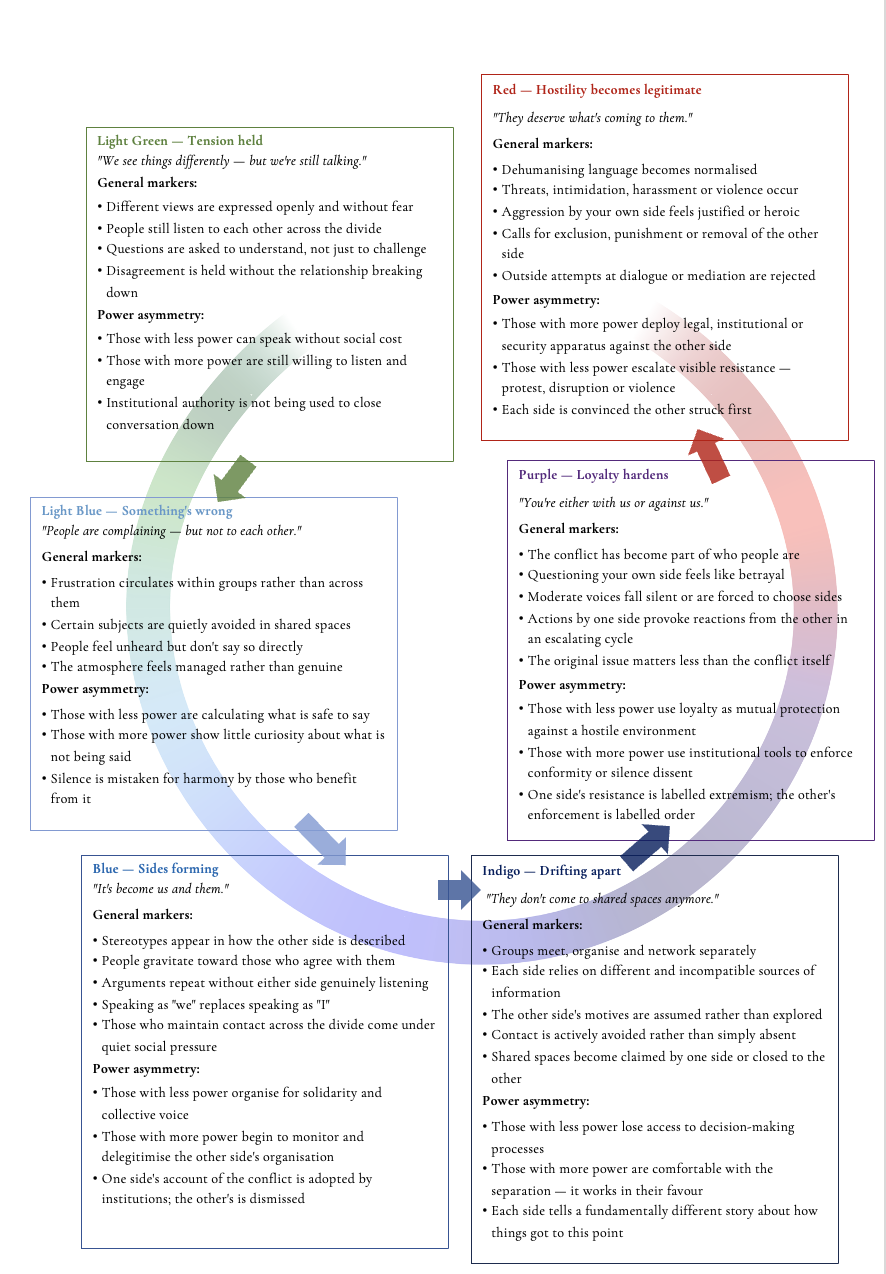
The Red Zone
“They deserve what’s coming to them.”
Light Green
Light Blue
Blue
Indigo
Purple
Red
The primary shifts between Purple and Red
From justification to legitimisation
In Purple, hostile action is discussed and contemplated within the group — it is justified internally but not yet enacted. In Red, that action has crossed into the world. Once violence, intimidation, or organised aggression occurs, something irreversible happens: it becomes a reference point. It happened. It can happen again. The other side now has concrete evidence for their narrative, and the acting group has established a precedent internally. The threshold, once crossed, is very hard to re-establish.
From moral framework to moral certainty
In Purple, strong moral language frames the conflict. In Red, that moral framework has hardened into certainty. Doubt — which is the prerequisite for dialogue — has been expelled. The other side is not just wrong but illegitimate, not just different but dangerous. This is the completion of the dehumanisation process that began at Purple. Once the other side’s humanity is no longer fully perceived, the normal moral restraints on behaviour toward them weaken or disappear entirely.
From identity to mission with urgency
Purple has a cause. Red has an imperative. The psychological shift is from “we must defend who we are” to “we must act now or it will be too late.” This urgency is partly manufactured — by activators, by external amplification, by the escalation cycle itself — but it is experienced as entirely real. It creates a tunnel vision that makes outside perspective almost impossible to introduce.
From internal enforcement to external aggression
Purple’s energy is largely directed inward — enforcing loyalty, silencing moderates, consolidating the group. Red’s energy turns outward. The target is no longer the waverer within the group but the enemy outside it. This outward turn is visible and measurable — in language, in incidents, in the physical claiming or threatening of spaces.
From process to incident-driven
In all the earlier zones, the practitioner could work with time — creating processes, building trust, preparing conversations. In Red, the dynamic is increasingly driven by incidents rather than processes. A provocation, a response, a counter-response. Each incident resets the situation and can undo weeks of careful relational work in hours. The practitioner loses the ability to set the pace.
The asymmetry at Red — its most extreme expression
In Red, the asymmetry between power-holder and resistor reaches its starkest form. The power-holder’s violence is institutional, organised, and dressed in legitimacy — law enforcement, exclusion orders, criminal prosecution. The resistor’s violence is visible, disruptive, and immediately labelled as aggression or terrorism. Each side’s violence confirms the other’s narrative. From inside each position, the other side struck first.
This is also where international or wider political contexts become most dangerous. If the local conflict maps onto a larger narrative — ethnic, religious, political — external actors may actively fuel it. Social media compresses time and removes geographic boundaries. A local incident becomes a global symbol overnight.
The shift in what intervention means
At every earlier zone, intervention meant entering the relational field — facilitating, mediating, supporting dialogue. At Red, intervention in that sense is largely no longer available. The relational field has been replaced by a conflict field. What intervention means now is different in kind:
For the regular practitioner: safety, referral, maintaining whatever thread of individual relationship still exists, and bearing witness without being drawn in.
For specialist actors — police, crisis mediators, negotiators, social services: de-escalation of immediate threat, containment, and the painstaking rebuilding of any channel through which a process might eventually become possible again.
For institutional decision-makers: the recognition that purely repressive responses at Red generate the conditions for Dark Red. Containment without any relational or structural component is not a solution — it is a deferral.
The most important thing about this shift:
Red is not a stable zone. It is inherently dynamic — tending either toward Dark Red if unchecked, or toward a slow and painful de-escalation if the right conditions can be created. That de-escalation does not move back through the zones quickly or smoothly. It is non-linear, fragile, and easily disrupted. But it is possible. The tool’s bidirectional arrow matters here more than anywhere else.
Red – Hostility Becomes Legitimate
The other side is no longer seen as a legitimate party with a different view — they are seen as a threat to be neutralised, expelled, or destroyed. Violence, aggression, and exclusion become morally justified within the group’s own framework. What was once recognised as a shared social or moral order has broken down. Where power is unequal, the Red zone looks profoundly different on each side: those with more power may deploy organised, institutional, or state-sanctioned force — which is dressed in the language of law, order, or security; those with less power may resort to visible, disruptive, or physical acts of resistance — which are dressed in the language of threat or criminality. Each side sees the other as having struck first.
General markers:
- Dehumanising language becomes normalised within the group.
Are people using language that strips the other side of their humanity — comparisons to animals, disease, or contamination? - Threats, intimidation, or harassment are directed at the other side.
Are members of the other side being personally threatened, intimidated, or harassed? - Sabotage, destruction of property, or physical violence occurs.
Has the conflict moved beyond words into physical acts of destruction or violence? - Calls for exclusion, removal, or punishment of the other side.
Are people openly demanding that the other side be removed, punished, or expelled? - Those with more power deploy legal, institutional, or security apparatus against the other side.
Are authorities using legal, administrative, or security forces to suppress, punish, or remove the other side?
Asymmetric power markers
- Those with less power escalate visible resistance — protest, disruption, or violence.
Are those who feel oppressed or cornered resorting to visible and disruptive acts of resistance? - Acts of aggression by one’s own side are justified or celebrated internally.
Are violent or aggressive acts by members of a group celebrated or justified within that group rather than questioned? - Outside attempts at mediation are rejected as naive, biased, or illegitimate.
Are offers of mediation or outside intervention being dismissed or actively resisted by one or both sides? - The humanity of individuals on the other side becomes increasingly difficult to perceive.
Can people on each side still recognise the other side as fully human — with families, fears, and legitimate needs?
Advice
A Note on Zone and Role
If you are a regular practitioner — a youth worker, a community facilitator, a teacher — this zone is beyond your direct intervention capacity unless you have specific experience of working with violent conflict. That is not a criticism. It is an honest account of what this zone requires.
And yet — as throughout this tool — your role does not end. What you carry into this zone is your relationships, your knowledge of the individuals involved, and your commitment to their safety and humanity. That is not nothing. At Red, it may be everything that remains available to a regular practitioner — and it matters.
The person best placed to work at Red is often the one who has been quietly present since Light Blue. Multi-partiality at Red cannot be claimed — it must already have been demonstrated. If you have been consistently present, consistently non-judgemental, and consistently honest with both sides from the earlier zones onward, that track record is your only credential. If you arrive at Red as a new actor claiming impartiality, you are unlikely to be believed by either side.
By the Red zone, trauma is not a background factor — it is a central one. Individuals on all sides, and bystanders, are likely to be experiencing trauma responses that affect perception, memory, trust, and the capacity for dialogue in ways that are not always visible. Hypervigilance, hair-trigger reactions, the inability to hear the other side without experiencing threat — these are not character flaws or signs of bad faith. They are trauma responses. Any intervention at Red requires trauma awareness as a baseline, and access to trauma-informed support for participants and practitioners alike.
Practitioner’s Stance
For the regular practitioner:
You are not the primary actor here — but you are not irrelevant. Hold that clearly. The temptation will be to do more — to convene one more meeting, to reach one more person, to prevent what feels preventable. That temptation, however well-intentioned, can cause harm at this stage. Knowing what you cannot do is as important as knowing what you can.
What you can do: stay present with the individuals you know. Support those at the receiving end of violence. Keep the relational thread alive — quietly, carefully, without publicising it. Maintain your presence with the bystanders and the wider community. Be the person who has not given up on the human beings involved, even when the conflict itself has become inhuman.
Support without flag-carrying remains the orientation — and at Red it is the hardest it has ever been. The young people you know may be doing things you find deeply wrong. Your presence with them will be read by others as endorsement. Hold the distinction clearly, document your reasoning, and seek supervision regularly. You cannot carry this alone.
Know your own triggers. At Red, the content of the conflict — the violence, the dehumanisation, the things being said and done — will provoke strong responses in any practitioner. Your own fear, anger, grief, or outrage are not unprofessional. They are human. But if they are not named and held consciously, they will shape your actions in ways you cannot control. Supervision is not optional at this stage. It is the condition that makes continued involvement responsible.
Be aware that your actions in this zone will be read politically by both sides. There is no neutral path — only a carefully reasoned, documented, and consciously made judgement about what the situation requires at each moment.
Immediate Response
For the regular practitioner:
Do:
- Prioritise the physical and psychological safety of everyone involved — participants, bystanders, and yourself.
- Support those at the receiving end of psychological or physical violence. Their need for care is immediate and should not wait for the conflict to be resolved.
- Maintain whatever individual relationships you still have — quietly, carefully, and without publicising them. Those threads may become important later.
- Consider whether any form of shared activity — however simple, however brief — can maintain a thread of human connection with individuals you can still reach. At Red this will not look like a programme or an intervention. It will look like showing up, being present, sitting alongside. Do not underestimate it.
- Distinguish clearly between law enforcement authorities and local or regional authorities. These are different actors with different roles, different relationships to the factions, and different implications for your own position.
- Document everything — what you observe, what you are told, what decisions you make and why, and what instructions you receive from above.
- Refer to specialists. Know who they are before you need them.
- Maintain your focus on the wider community — the bystanders, the uninvolved young people, those being frightened or quietly recruited. They need support now, and they are the community within which recovery will eventually need to happen. Do not let the intensity of the immediate conflict make them invisible.
Don’t:
- Attempt direct mediation or convene any joint process unless you have specific experience of violent conflict.
- Force a role that is no longer credible. If your institutional affiliation has made you untrustworthy in the eyes of one or both factions, accept that and step back from direct intervention.
- Involve law enforcement automatically or without careful thought about how that involvement will be read by each faction — particularly where law enforcement is itself perceived as a party to the conflict.
- Leave those experiencing violence without support while the larger conflict is being managed. Individual human need does not pause for process.
- Carry this alone. Collegial support and supervision are essential.
Holding the Wider Community
At Red, the wider community — those not directly involved in the active conflict — is experiencing something that will leave marks. Young people are watching violence or the threat of it. They are being sorted, pressured, frightened. Some are being recruited. Some are withdrawing entirely. Some are carrying experiences they have no language for and no safe space to process.
The regular practitioner’s most important long-term contribution at this stage may be here — not in the conflict itself, which is beyond their direct reach, but in the community around it. Creating spaces where uninvolved young people can speak about what they are experiencing, feel supported, and maintain some sense of safety and continuity is not peripheral work. It is the ground on which recovery will eventually be built.
It is also, practically, the place where the practitioner’s relationships and skills remain most fully available. The relational work that is no longer possible with the hardened factions is still possible here — and it matters enormously.
Ask yourself: who is not in the room — and what do they need from me right now?
Dialogue Beyond Words
At Red, the idea of structured dialogue between sides is largely not available. But the principle of human connection through shared activity does not disappear — it simply becomes more intimate, more personal, more patient.
A practitioner who can sit with a young person involved in or affected by violence, and offer presence without agenda — cooking together, walking, making something — is offering something that no formal process can replicate. It does not resolve the conflict. It maintains the humanity of the relationship across it. And that humanity is the seed from which anything that follows must grow.
The trust built in the green zones is the resource drawn on here. The way back from Red runs through the relationships that were built long before the conflict reached this point. That is not a reason for despair — it is the single most important structural insight in the entire tool, and it is the reason why the work done at Light Green and Light Blue matters so profoundly.
Ask yourself: what human connection is still possible here — and am I offering it?
Advice for the Specialist Mediator
A note:
Be aware that digital spaces may be actively disrupting the process. A ceasefire negotiated in the room can be undermined within hours by what is circulating online. Social media compresses time and removes geographic boundaries — a local incident becomes a global symbol overnight, and external actors may be deliberately feeding the narrative. Build awareness of this dynamic into the process from the start. Where possible, identify whether there are specific online spaces or actors that are amplifying the conflict, and ensure that decision-makers are aware of this dimension. It is not the mediator’s role to manage digital spaces — but ignoring them is no longer possible.
Mediator’s stance:
Your independence is your primary asset and must be protected at every step. Both factions and, where relevant, the authorities need to understand your role clearly: you are not an instrument of any party, you are not a conduit for intelligence, and you are not a representative of the institution that employed you. If any of those boundaries are compromised, your effectiveness ends.
Be aware that by Red, both sides are likely operating from trauma responses as much as from rational calculation. Patience, steadiness, and the capacity to absorb hostility without reacting are not just personal qualities — they are professional requirements.
Immediate response
Do:
- Establish the distinction between physical violence and psychological violence early. If physical violence has occurred or is ongoing, a ceasefire must be negotiated before any mediation process can begin. Mediation cannot occur while violence is active.
- Make initial contact with each faction separately. The first goal is not dialogue — it is the negotiation of willingness to engage in a process at all.
- Identify key figures or leaders in each faction. They are the entry point for any negotiation and the people whose buy-in makes a process possible.
- Consider back-channel contacts where direct engagement is not yet possible. Be transparent about the existence of back channels even when their content must remain confidential — secrecy about the process itself will be read as bias.
- Differentiate clearly between law enforcement authorities and local or regional authorities in your engagement. Where law enforcement is itself a party to the conflict, your relationship with them requires the same careful multipartiality as your relationship with any other faction.
- Document every contact, every communication, every decision. This is protective for you and may be essential for any formal process that follows.
Don’t:
- Attempt mediation while violence is ongoing. The precondition for any dialogue is a sufficient reduction in immediate threat.
- Allow yourself to become a messenger — carrying positions, accusations, or provocations between factions. You carry understanding and process, not messages.
- Mistake a ceasefire for resolution. The absence of active violence is the beginning of the work, not the end.
- If mediation cannot be established, treat this as simply handing the situation to law enforcement. The mediator’s responsibility at that point is to document the situation fully, communicate clearly to all parties what was attempted and why it was not possible, and ensure that the risks and likely consequences of non-intervention are formally and explicitly on record. That record may be the most important contribution the mediator makes.
Longer term
- Once initial contact is established and willingness to engage is negotiated, move toward a structured mediation process: agreed ground rules, separate preparation of each faction, space for each side to articulate their needs and red lines, joint exploration of underlying causes, and a generative phase aimed at agreement or at minimum a sustainable reduction in hostility.
- Maintain constant awareness of escalation risk. A single incident — real or perceived — can undo significant progress. Build incident-response protocols into the process from the start: what happens if something occurs during the mediation period?
- Attend to trauma throughout. The capacity of individuals to participate in dialogue is directly affected by their trauma state. Access to trauma-informed support should be built into the process, not added as an afterthought.
- Keep local and regional authorities informed where they are not parties to the conflict. Their support — or at minimum their non-interference — may be necessary for any agreement to hold.
For Institutional and Political Decision-Makers
The questions this tool asks of institutional decision-makers at Red are ultimately the same questions it has been asking since Light Blue — they have simply become urgent and expensive. The silence that was mistaken for harmony in the Light Blue zone, the organising that was treated as a threat rather than a legitimate response in the Blue zone, the separation that was left to become structural in the Indigo zone — these are the conditions that produced what is now in front of you.
Purely repressive responses at Red confirm the narrative of the less powerful faction, remove the last practitioners with relational access, and regenerate the conditions of marginalisation that drove escalation in the first place. The cost is deferred, not avoided — and it accumulates interest.
The questions that need to be asked now are the same ones that needed to be asked then — but the cost of answering them has multiplied at every stage:
Are we addressing the structural conditions that drove this escalation — exclusion, marginalisation, lack of voice, unmet need?
Are we protecting the practitioners and mediators who still have relational access, or are our instructions destroying that access in the name of order?
Are we distinguishing between containing immediate threat and resolving underlying conflict — and are we resourcing both?
Are we honest about the role our own institution has played — the Purple-zone moves dressed in the language of security, the silence mistaken for harmony, the framing adopted that served one side?
And are we investing now in the community around the conflict — the bystanders, the uninvolved, the frightened — who will carry this experience forward long after the immediate crisis has passed?
The temptation at Red is to respond with force, exclusion, and the full weight of institutional authority. That response is understandable. It is also, without exception, insufficient on its own — and frequently counterproductive.
Purely repressive responses at Red do several things simultaneously: they confirm the narrative of the less powerful faction that the system is the enemy; they remove the last practitioners who have relational access to those at risk; they generate the conditions of humiliation and marginalisation that drove escalation in the first place; and they defer rather than resolve the underlying conflict, typically at greater cost.
This is not an argument against law enforcement involvement where safety requires it. It is an argument that law enforcement without a parallel relational and structural response accelerates the path toward Dark Red.
The questions institutional decision-makers need to ask at this stage are:
Are we addressing the structural conditions that drove this escalation — exclusion, marginalisation, lack of voice?
Are we protecting the practitioners and mediators who still have relational access, or are our instructions destroying that access?
Are we distinguishing between containing immediate threat and resolving underlying conflict — and are we resourcing both?
Are we documenting our own decisions and their consequences with the same rigour we expect of practitioners on the ground?
Signs of Escalation Toward Dark Red
The following signals suggest that the zone is shifting toward something that exceeds the scope of this tool entirely:
- Violence is no longer reactive or episodic — it is becoming organised, planned, and directed at a group as a whole rather than at individuals.
- Dehumanising language has become official, normalised, and systematic — the other group is referred to in ways that strip them entirely of humanity.
- Institutional or state apparatus is being deployed not to contain violence but to direct it.
- Bystanders are facing pressure to participate or are being criminalised for protecting members of the other group.
- The other group is being stripped of legal standing, access to resources, or civil existence.
- Denial of what is happening runs alongside the happening of it.
These are the markers of Dark Red — a zone that sits beyond the scope of this tool’s intervention advice, included not because practitioners are expected to work within it, but because its existence marks the horizon that the entire tool is designed to help people avoid reaching.
Important Note
Red is not a stable zone. It tends either toward Dark Red if unchecked, or toward a slow and painful de-escalation if the right conditions can be created. That de-escalation does not move back through the zones quickly or smoothly. It is non-linear, fragile, and easily disrupted. But it is possible. The way back runs through the relationships built long before the conflict reached this point — through the trust established at the green end of the scale, through the moments of human contact that were maintained even as everything else was hardening. The arrow points both ways. That is not optimism. It is the most important practical truth in this entire tool.
The primary shifts between Purple and Red
From justification to legitimisation
In Purple, hostile action is discussed and contemplated within the group — it is justified internally but not yet enacted. In Red, that action has crossed into the world. Once violence, intimidation, or organised aggression occurs, something irreversible happens: it becomes a reference point. It happened. It can happen again. The other side now has concrete evidence for their narrative, and the acting group has established a precedent internally. The threshold, once crossed, is very hard to re-establish.
From moral framework to moral certainty
In Purple, strong moral language frames the conflict. In Red, that moral framework has hardened into certainty. Doubt — which is the prerequisite for dialogue — has been expelled. The other side is not just wrong but illegitimate, not just different but dangerous. This is the completion of the dehumanisation process that began at Purple. Once the other side’s humanity is no longer fully perceived, the normal moral restraints on behaviour toward them weaken or disappear entirely.
From identity to mission with urgency
Purple has a cause. Red has an imperative. The psychological shift is from “we must defend who we are” to “we must act now or it will be too late.” This urgency is partly manufactured — by activators, by external amplification, by the escalation cycle itself — but it is experienced as entirely real. It creates a tunnel vision that makes outside perspective almost impossible to introduce.
From internal enforcement to external aggression
Purple’s energy is largely directed inward — enforcing loyalty, silencing moderates, consolidating the group. Red’s energy turns outward. The target is no longer the waverer within the group but the enemy outside it. This outward turn is visible and measurable — in language, in incidents, in the physical claiming or threatening of spaces.
From process to incident-driven
In all the earlier zones, the practitioner could work with time — creating processes, building trust, preparing conversations. In Red, the dynamic is increasingly driven by incidents rather than processes. A provocation, a response, a counter-response. Each incident resets the situation and can undo weeks of careful relational work in hours. The practitioner loses the ability to set the pace.
The asymmetry at Red — its most extreme expression
In Red, the asymmetry between power-holder and resistor reaches its starkest form. The power-holder’s violence is institutional, organised, and dressed in legitimacy — law enforcement, exclusion orders, criminal prosecution. The resistor’s violence is visible, disruptive, and immediately labelled as aggression or terrorism. Each side’s violence confirms the other’s narrative. From inside each position, the other side struck first.
This is also where international or wider political contexts become most dangerous. If the local conflict maps onto a larger narrative — ethnic, religious, political — external actors may actively fuel it. Social media compresses time and removes geographic boundaries. A local incident becomes a global symbol overnight.
The shift in what intervention means
At every earlier zone, intervention meant entering the relational field — facilitating, mediating, supporting dialogue. At Red, intervention in that sense is largely no longer available. The relational field has been replaced by a conflict field. What intervention means now is different in kind:
For the regular practitioner: safety, referral, maintaining whatever thread of individual relationship still exists, and bearing witness without being drawn in.
For specialist actors — police, crisis mediators, negotiators, social services: de-escalation of immediate threat, containment, and the painstaking rebuilding of any channel through which a process might eventually become possible again.
For institutional decision-makers: the recognition that purely repressive responses at Red generate the conditions for Dark Red. Containment without any relational or structural component is not a solution — it is a deferral.
The most important thing about this shift:
Red is not a stable zone. It is inherently dynamic — tending either toward Dark Red if unchecked, or toward a slow and painful de-escalation if the right conditions can be created. That de-escalation does not move back through the zones quickly or smoothly. It is non-linear, fragile, and easily disrupted. But it is possible. The tool’s bidirectional arrow matters here more than anywhere else.
Back to the top
An Overview of all the Zones